
Top 15 RFID Applications in the Manufacturing Industry
Modern manufacturers live and die by visibility. When you cannot see where materials, products, tools, and assets are at any given moment, delays, errors, and lost inventory follow. That is why so many plants are turning to radio frequency identification. The top 15 RFID applications in the manufacturing industry all share one goal: helping manufacturers identify and track things automatically, in real time, throughout their operations.
It is worth saying up front that RFID is not automatically better than barcode. Both are valuable, and the right choice depends on the process, environment, budget, and operational requirements — a topic we explore in our guide on RFID vs barcode. This article focuses on where RFID genuinely adds value on the factory floor.
▶ Watch: RFID Solutions Overview
What Is RFID in Manufacturing?
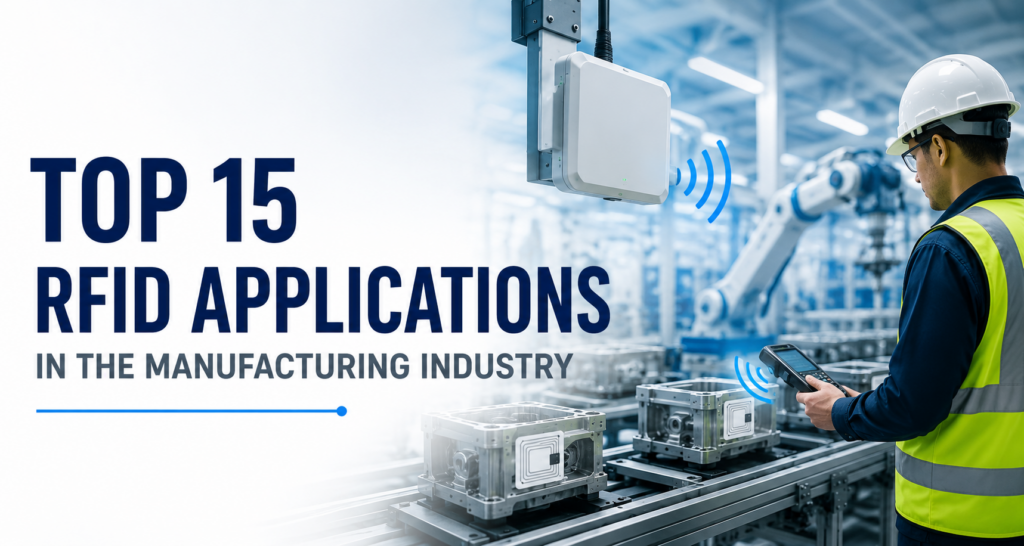
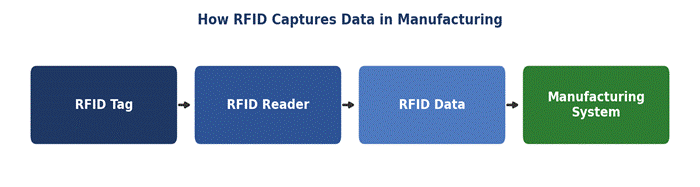
RFID, or radio frequency identification, uses radio waves to identify tagged items automatically. An RFID tag — a small chip and antenna — is attached to a material, product, tool, or asset. RFID readers and antennas emit radio waves that power the tag and read its unique ID, with no line of sight required. RFID software then turns those reads into usable data.
In a plant, that data flows into your manufacturing, WMS, or ERP systems, so a physical movement instantly becomes a digital record. If you are new to the technology, our guide on what RFID is and how it works explains the basics in detail.
Why Is RFID Important for Manufacturing?
RFID matters because it replaces slow, manual tracking with automatic, real-time data. The practical benefits include:
- Real-time visibility of materials, products, and assets across the plant.
- Automated data capture that removes manual scanning and typing.
- Improved inventory accuracy and fewer manual errors.
- Better asset and tool tracking, plus stronger production and process visibility.
- Improved traceability and operational efficiency.
- Support for Industry 4.0 and connected, data-driven manufacturing.
The 15 Applications at a Glance
Here is a quick overview before we look at each one in detail:
| # | Application | What it tracks |
| 1 | Raw Material Tracking | Incoming raw materials & batches |
| 2 | Inventory Management | Stock levels across the plant |
| 3 | Work-in-Progress (WIP) Tracking | Components between production stages |
| 4 | Finished Goods Tracking | Completed products before dispatch |
| 5 | Tool Tracking | Production tools on the shop floor |
| 6 | Equipment & Asset Tracking | Machinery, fixtures & equipment |
| 7 | Production Line Tracking | Items passing each station |
| 8 | Quality Control | Inspection data per item |
| 9 | Production Sequencing | Correct parts, correct order |
| 10 | Automated Material Handling | Materials on conveyors, AGVs, robots |
| 11 | Maintenance & Calibration Tracking | Service & calibration history |
| 12 | Supply Chain Visibility | Goods between suppliers & sites |
| 13 | Returnable Transport Item Tracking | Reusable containers, pallets, racks |
| 14 | Product Traceability | Full history, material to product |
| 15 | Compliance & Recall Management | Affected batches & products |
Top 15 RFID Applications in the Manufacturing Industry
Now let’s explore each application, from the loading dock to the finished-goods store.
1. Raw Material Tracking
Tagging incoming raw materials lets RFID readers log each batch the moment it arrives and follow it into production. Manufacturers see exactly what stock is on hand and where it sits, without manual counts. This improves inventory accuracy, prevents shortages that stall the line, and forms the first link in the traceability chain from goods-in to finished product.
2. Inventory Management
RFID delivers real-time inventory visibility across the plant. As tagged materials and parts move, readers update stock automatically, keeping counts accurate without manual scanning. Managers can identify stock, spot low inventory levels, and reorder before a stockout. The result is leaner inventory, less safety stock, and fewer production delays caused by missing components.
3. Work-in-Progress (WIP) Tracking
Work-in-progress is notoriously hard to see. RFID tags on components and sub-assemblies let readers record each item as it moves between production stages, giving a live view of what is where on the line. This helps identify bottlenecks, estimate completion times, and reduce lost or misplaced work — turning a black box into a transparent, measurable flow.
4. Finished Goods Tracking
Once products are complete, RFID tracks them from the end of the line to storage, dispatch, or shipping. Readers confirm quantities and locations automatically, so nothing is miscounted or misplaced before it leaves. This speeds up dispatch, keeps finished-goods inventory accurate, and helps ensure the right products reach the right orders on time.
5. Tool Tracking
Production tools are easily misplaced across a busy shop floor. RFID tags on tools let staff locate them in seconds and see who used them last. This cuts the time wasted searching, reduces tool loss, and ensures critical tools are available when a job needs them — keeping production moving instead of waiting.
6. Equipment & Asset Tracking
High-value machinery, fixtures, and portable equipment can all be tagged and tracked with RFID. Readers record location and movement, so assets are easy to find and less likely to go missing. Manufacturers gain a clear register of what they own and where it is, improving utilisation and audits.
7. Production Line Tracking
RFID identifies products or components as they pass each production station. Readers automatically log progress, so supervisors see throughput and status in real time without manual data entry. This supports better line balancing, faster response to stoppages, and accurate records of exactly what was produced and when.
8. Quality Control
By linking a tagged product or component to its inspection and production data, RFID ties quality records to individual items. If a defect appears, staff can review that item’s history — materials, station, and checks. This tightens quality control and keeps a reliable record for every unit.
9. Production Sequencing
Complex assembly depends on the right parts reaching the right station in the right order. RFID verifies that each tagged component matches the correct sequence before it is used, catching mismatches automatically. This reduces assembly errors, protects product quality, and keeps mixed-model production lines running smoothly.
10. Automated Material Handling
RFID works hand in hand with conveyors, AGVs, and robots by identifying materials so those systems know what to move and where. A reader confirms an item’s ID, and the connected equipment routes it automatically — making automated material handling reliable and hands-free.
11. Maintenance & Calibration Tracking
Tagging machines and tools lets RFID hold their service and calibration history. Staff scan an asset to see when it was last maintained and when it is next due, supporting planned upkeep instead of reactive fixes. This reduces unexpected breakdowns, keeps calibrated tools compliant, and helps extend equipment life.
12. Supply Chain Visibility
RFID extends beyond the factory walls. Tagging materials and products as they move between suppliers, plants, and distribution points gives clearer supply chain visibility. Each read adds a checkpoint, so manufacturers know where goods are in transit and can plan around delays.
13. Returnable Transport Item Tracking
Reusable containers, pallets, bins, and racks represent real capital that often goes missing. RFID tags let manufacturers track these returnable assets as they circulate, so fewer are lost and more are reused. This lowers replacement costs and keeps material flowing without container shortages.
14. Product Traceability
RFID can maintain an unbroken record from raw material through every production stage to the finished product. Because each read is logged automatically, manufacturers can trace any unit’s full history on demand. This traceability is invaluable for quality assurance, customer confidence, and meeting the documentation many industries require.
15. Compliance & Recall Management
When a recall or audit is needed, RFID-generated records make it far faster to identify affected products and batches. Instead of manual searches, manufacturers query the data to pinpoint exactly which units are involved and where they went. This supports compliance, limits the scope of recalls, and protects both customers and reputation.
RFID Applications by Manufacturing Industry
RFID is used differently across sectors. A few common examples:
| Industry | Example RFID application |
| Automotive | Parts and assembly tracking |
| Pharmaceutical | Product and batch traceability |
| Electronics | Component and WIP tracking |
| Aerospace | High-value component tracking |
| Food & Beverage | Material and product tracking |
| Textile | Raw material and finished goods tracking |
| Engineering | Tool and asset tracking |
| Chemicals | Container and material tracking |
RFID and Manufacturing Automation
RFID is most powerful as part of a connected operation. It acts as an identification and data-capture layer, feeding accurate information to the systems around it — a warehouse management system, ERP, conveyors, AGVs, and robots.
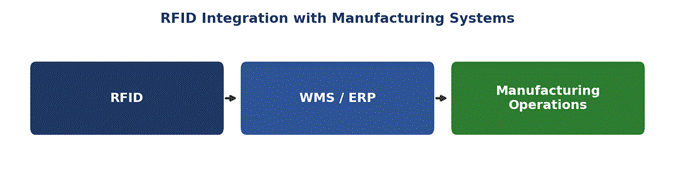
In each case, RFID tells the connected system what an item is, and the system decides what to do with it. That is why RFID sits at the heart of so much warehouse and manufacturing automation — it turns physical items into data the rest of the plant can act on.
How to Choose the Right RFID Application
There is no single RFID setup that suits every manufacturer. Before choosing, evaluate:
- What needs to be tracked, and the required read distance and speed
- Material type, and whether the environment involves metal or liquids
- Tag durability and the conditions on your production floor
- Your existing WMS or ERP, and how RFID will integrate
- Budget today and your future automation plans
Best Practices for Implementing RFID in Manufacturing
A successful rollout follows a clear sequence — the same discipline we cover in our guide to implementing RFID:
- Identify the business problem you want to solve.
- Select the right RFID tags for your goods.
- Select suitable readers and antennas.
- Design reader locations carefully.
- Integrate RFID with your existing software.
- Start with a pilot in one area.
- Test read performance around your products.
- Train employees on the new workflow.
- Measure results against your goals.
- Scale gradually across the plant.
The Future of RFID in Manufacturing
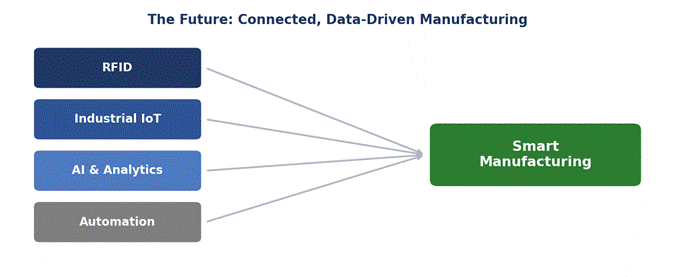
RFID is becoming a core sense of the smart factory. As Industry 4.0 matures, RFID data combines with IoT sensors and AI to power real-time analytics, automated material handling, and predictive maintenance. Connected manufacturing systems increasingly rely on RFID to know what is happening on the floor, making operations more responsive and more autonomous over time.
Conclusion
RFID has found a home across almost every part of manufacturing — inventory, production, assets, tools, quality, traceability, material handling, and supply chain visibility. Its strength is simple: it turns physical items into real-time data your systems can act on.
Still, RFID is not a one-size-fits-all answer, and it does not universally replace barcode; the two often work best together. The right RFID solution depends on your processes, environment, operational goals, and automation strategy — which is why planning around your specific needs matters most.
Improve Manufacturing Visibility with RFID
Brilliant Info Systems provides RFID and RTLS solutions, warehouse management solutions, warehouse automation, and Industry 4.0 solutions for manufacturers. If you want to improve tracking, traceability, and automation across your operations, contact our team to discuss your manufacturing requirements.
Frequently Asked Questions
What is RFID used for in manufacturing?
RFID is used to automatically identify and track materials, work-in-progress, finished goods, tools, and assets throughout manufacturing operations, providing real-time visibility and data to connected systems.
What are the main applications of RFID in manufacturing?
Common applications include raw material tracking, inventory management, WIP tracking, tool and asset tracking, quality control, production sequencing, traceability, and supply chain visibility.
How does RFID improve inventory management?
RFID updates stock automatically as tagged items move, without manual scanning. This keeps inventory levels accurate in real time, reduces stockouts, and lowers the safety stock needed to cover uncertainty.
Can RFID track work-in-progress?
Yes. Tagging components and sub-assemblies lets readers record each item as it moves between stages, giving a live view of WIP and helping identify bottlenecks on the line.
Can RFID integrate with WMS and ERP?
Yes. RFID acts as a data-capture layer that feeds reads into your WMS and ERP, so inventory, production, and order records update automatically across your systems.
Is RFID suitable for every manufacturing environment?
Not always. Factors such as metal, liquids, read distance, and budget affect suitability. The right tags and reader placement — and sometimes a barcode-RFID hybrid — make it work in most settings, but each case should be assessed.