
How Environmental Sensors Are Transforming Mining Site Monitoring
Mining has always been a balancing act between production and responsibility. Every site must move raw materials efficiently while protecting workers, nearby communities, and the environment around it. For decades, that meant periodic manual checks — a dust reading here, a water sample there — that gave only occasional snapshots. Environmental sensors have changed the picture entirely, turning those snapshots into a continuous, live view of the whole site.
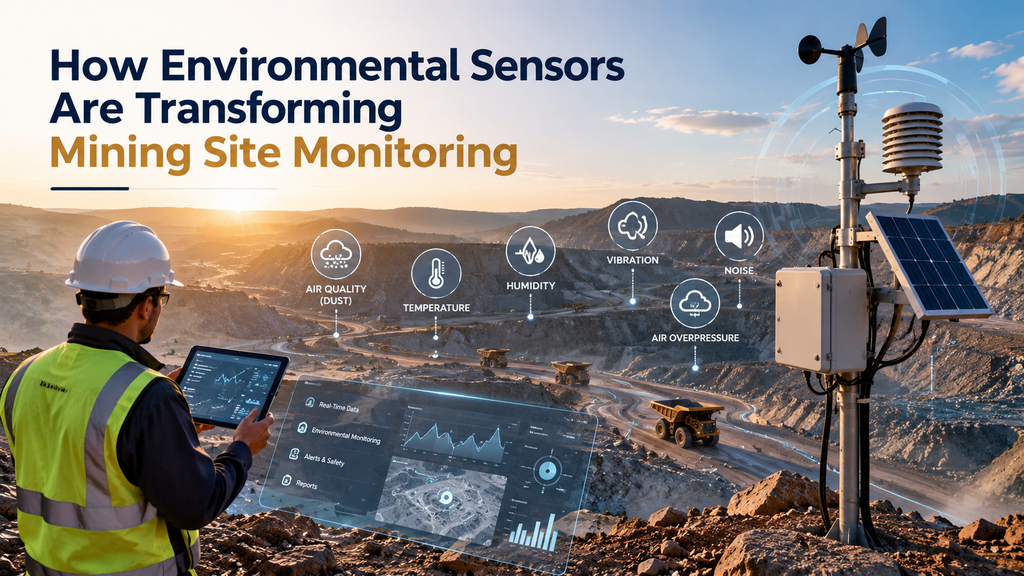
By capturing real-time data on air, water, ground, and weather conditions, environmental sensors in mining give operators the insight to work more safely and sustainably. This guide explains what these sensors are, what they monitor, how they work, and how they are transforming mining environmental monitoring across modern sites.
▶ Watch: Real-Time IoT Monitoring in Action
Table of Contents
- What are environmental sensors in mining?
- Why mining needs environmental monitoring
- What environmental sensors monitor
- How they work
- Transforming site monitoring
- The benefits
- Smart mining and the future
- Best practices
- FAQs and conclusion
What Are Environmental Sensors in Mining?
Environmental sensors are connected devices that continuously measure environmental conditions across a mine site — air quality, water quality, dust, noise, weather, and ground movement. Built on the internet of things (IoT), these monitoring sensors feed live readings and real time data to a central platform, replacing occasional manual sampling with constant, automatic oversight.
They are the environmental arm of the wider shift toward smart mining technologies. Where industrial IoT connects equipment and processes, environmental sensors connect the site’s surroundings — giving a complete, real-time picture of a mine’s impact on the world around it.
Why Mining Needs Environmental Monitoring
Mining sites face intense scrutiny, and for good reason. Operations affect air, water, and land over a wide area, and a single incident can harm health, damage ecosystems, and halt production. Continuous environmental monitoring is now essential for several connected reasons:
- Safety and sustainability: protecting workers and the environment is both a duty and a licence to operate.
- Regulatory compliance: operations must prove they stay within legal environmental limits at all times.
- Community trust: nearby residents expect transparency on dust, noise, and water quality.
- Early warning: real time monitoring catches problems, such as slope movement, before they become disasters.
Manual, periodic checks simply cannot deliver this. Only continuous sensing provides the always-current data these responsibilities demand.
What Environmental Sensors Monitor
A modern mine deploys a range of environmental sensors, each watching a different aspect of the site. Together they build a full environmental picture:
| Environmental sensor | What it monitors and why it matters |
| Air quality sensor | Dust and gas levels that affect worker health and nearby communities |
| Water quality sensor | pH, turbidity, and contamination to protect surrounding water sources |
| Dust & noise sensor | Airborne dust and noise that impact health and trigger complaints |
| Weather station | Wind, rain, and temperature that affect dust spread and safe operations |
| Slope stability sensor | Ground movement on pit walls and dumps to prevent collapses |
| Vibration sensor | Blast and equipment vibration affecting structures and machinery |
Vibration sensing deserves special mention: the same technology behind a blast vibration monitoring solution protects nearby structures from blasting, complementing the broader environmental network.
A Closer Look at Key Monitoring Areas
While environmental sensors cover many aspects of a site, a few areas matter most and show clearly how the technology transforms monitoring.
Air quality monitoring tracks dust and gases across the site in real time, protecting workers from harmful exposure and warning communities before dust drifts beyond the boundary. In an open pit, where dust is a constant challenge, continuous air quality data is invaluable for both health and compliance.
Water quality monitoring watches pH, turbidity, and contamination in the water around and downstream of a site. Because mining can affect groundwater and rivers, real time water data protects surrounding ecosystems and provides the evidence regulators require.
Slope stability monitoring may be the most safety-critical of all. Sensors detect the tiny ground movements that precede a slope failure on pit walls or waste dumps, giving early warning that can save lives. Paired with vibration data from a blast monitoring sensor network, it gives a complete view of ground behaviour across the site.
How Environmental Sensors Work
The principle is the same across sensor types. Devices placed around the site detect environmental conditions and convert them into data. That data travels over an IoT network to a cloud platform, where it is analysed in real time and turned into dashboards and alerts. Connected smart sensors make this continuous flow possible across a large, spread-out site.
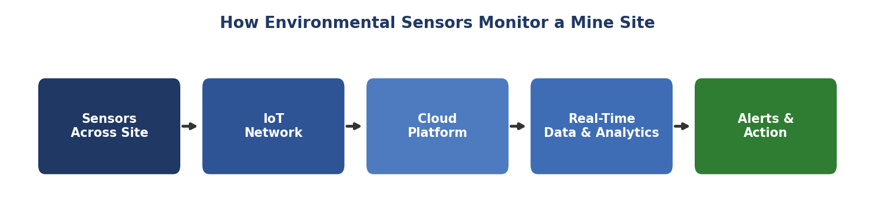
Because everything is captured automatically, managers get a live, always-current view rather than a monthly report. When a reading crosses a limit — a dust spike, a shift in a pit wall — the system alerts the team immediately, so they can act before the situation escalates.
How Sensors Are Transforming Mining Site Monitoring
The shift from periodic checks to continuous sensing changes how mines operate day to day. In an open pit, air quality and dust sensors track conditions across the whole site in real time, while slope stability sensors watch pit walls and waste dumps for the tiny movements that precede a collapse.
Sensors also extend to mobile equipment. Monitoring the environment around haul trucks and other machinery helps manage dust, emissions, and safety, and the same data supports predictive maintenance of the fleet. Fed into big data analytics, all of these streams combine into a single, intelligent view of the site — the essence of smart mining.
The Benefits of Environmental Sensors in Mining
Beyond meeting obligations, environmental sensors pay their way. Deploying them delivers advantages that reach across safety, compliance, and the bottom line:
- Improved safety: real-time alerts on air quality and slope stability protect workers from harm.
- Stronger sustainability: continuous data helps minimise environmental impact and prove it.
- Easier compliance: always-current records make demonstrating compliance straightforward.
- Lower operational costs: early warnings prevent costly incidents, downtime, and remediation.
- Better decisions: live environmental data informs planning, from blasting to haulage.
- Community confidence: transparent monitoring builds trust with regulators and neighbours.
Regulation, Reputation and the Social Licence to Operate
Beyond the technical benefits, environmental sensors have become central to how a mine earns and keeps its social licence to operate. Regulators increasingly expect continuous, verifiable data rather than occasional reports, and communities near a site want reassurance that dust, noise, and water are being watched around the clock. Continuous environmental monitoring provides exactly that — an objective, always-current record that can be shared openly.
This transparency changes the relationship between a mine and its neighbours. When a complaint arises, real-time data quickly shows whether limits were exceeded, resolving disputes on facts rather than perception. Over time, a visible commitment to monitoring builds the trust that lets an operation grow, expand, or renew its permits with far less friction. In an industry where reputation can be as valuable as reserves, that is a significant return on a relatively modest investment.
Smart Mining Technologies and the Future
Environmental sensors are a cornerstone of smart mining technologies, and their role is growing. As IoT, big data, and AI mature, the data from these sensors increasingly feeds predictive models — forecasting dust dispersion from weather conditions, or flagging slope instability before it is visible. A digital twin of the site can even model environmental scenarios virtually.
The direction is clear: from monitoring what has happened to predicting what will. Combined with monitoring solutions like real-time blast and ground vibration monitoring, environmental sensing is making mines safer, cleaner, and more autonomous.
Best Practices for Environmental Monitoring
To get the most from environmental sensors, place them where the risks and impacts are greatest — near communities, water sources, and unstable ground. Choose real-time, connected monitoring systems rather than manual sampling, and integrate all sensor streams into one platform so the data tells a single story. Keep sensors calibrated for accurate data, set clear alert thresholds tied to regulations, and review the accumulated data regularly to spot trends and improve. Above all, treat monitoring as continuous, not occasional.
Challenges to Plan For
Deploying environmental sensors across a large mine is powerful but not effortless. Sites are vast and often remote, so reliable connectivity and power for every sensor must be planned. Harsh conditions — dust, moisture, temperature swings, and vibration — demand rugged equipment and regular calibration to keep data accurate. The sheer volume of data means analytics and clear dashboards matter as much as the sensors themselves, or the readings never become action.
Integration is the final challenge: air, water, weather, slope, and vibration data are most useful when combined into one platform rather than scattered across separate tools. The same principle applies to blasting, where a blast vibration and air overpressure record belongs in the same environmental picture. Planning for these realities up front, ideally with an experienced partner, is what turns a scatter of sensors into a genuine monitoring system.
Conclusion
Environmental sensors have transformed mining site monitoring from occasional manual checks into continuous, real-time oversight of air, water, ground, and weather. That shift is helping mines protect workers and communities, meet tightening regulations, and operate more sustainably — all while lowering the cost of incidents and downtime.
As smart mining technologies advance, environmental sensing will only become more central to safe, responsible operations. Combined with focused monitoring solutions such as a blast vibration monitoring solution, environmental sensors give mining teams the complete, live picture they need to run a modern site.
Modernise Mining Monitoring with Brilliant Info Systems
Brilliant Info Systems delivers IoT-powered environmental and site monitoring — from IoT and smart sensors to blast vibration monitoring and predictive maintenance. Contact our team to transform monitoring across your mining site.
Frequently Asked Questions
What are environmental sensors in mining?
They are connected IoT devices that continuously measure environmental conditions across a mine — air quality, water quality, dust, noise, weather, and ground movement — feeding real-time data to a central platform for monitoring and alerts.
Why is environmental monitoring important in mining?
It protects workers, communities, and the environment, ensures regulatory compliance, and gives early warning of hazards such as slope instability — allowing mines to operate safely and sustainably.
What do environmental sensors monitor at a mine?
Common targets include air quality and dust, water quality, noise, weather conditions, slope stability, and blast or equipment vibration — together giving a complete picture of a site’s environmental impact.
How do environmental sensors work?
Sensors around the site detect conditions and send the data over an IoT network to a cloud platform, where it is analysed in real time. When a reading exceeds a limit, the system alerts the team immediately.
How do environmental sensors reduce operational costs?
By catching problems early — a dust exceedance, slope movement, or equipment issue — they prevent costly incidents, downtime, fines, and remediation, while supporting predictive maintenance of the fleet.
Are environmental sensors part of smart mining?
Yes. They are a core smart mining technology, feeding real-time data and big data analytics that make mines safer, more sustainable, and increasingly predictive.