
How Integrated Monitoring Platforms Improve Mining Site Visibility
A modern mine runs dozens of monitoring systems — one for blast vibration, another for air quality, others for dust, equipment health, vehicles, and more. The problem is that these systems often work in isolation, each with its own screen, login, and data. A manager trying to understand what is happening across the whole site has to jump between them, piecing together a picture from scattered parts. Integrated monitoring platforms solve this by bringing everything into one view.
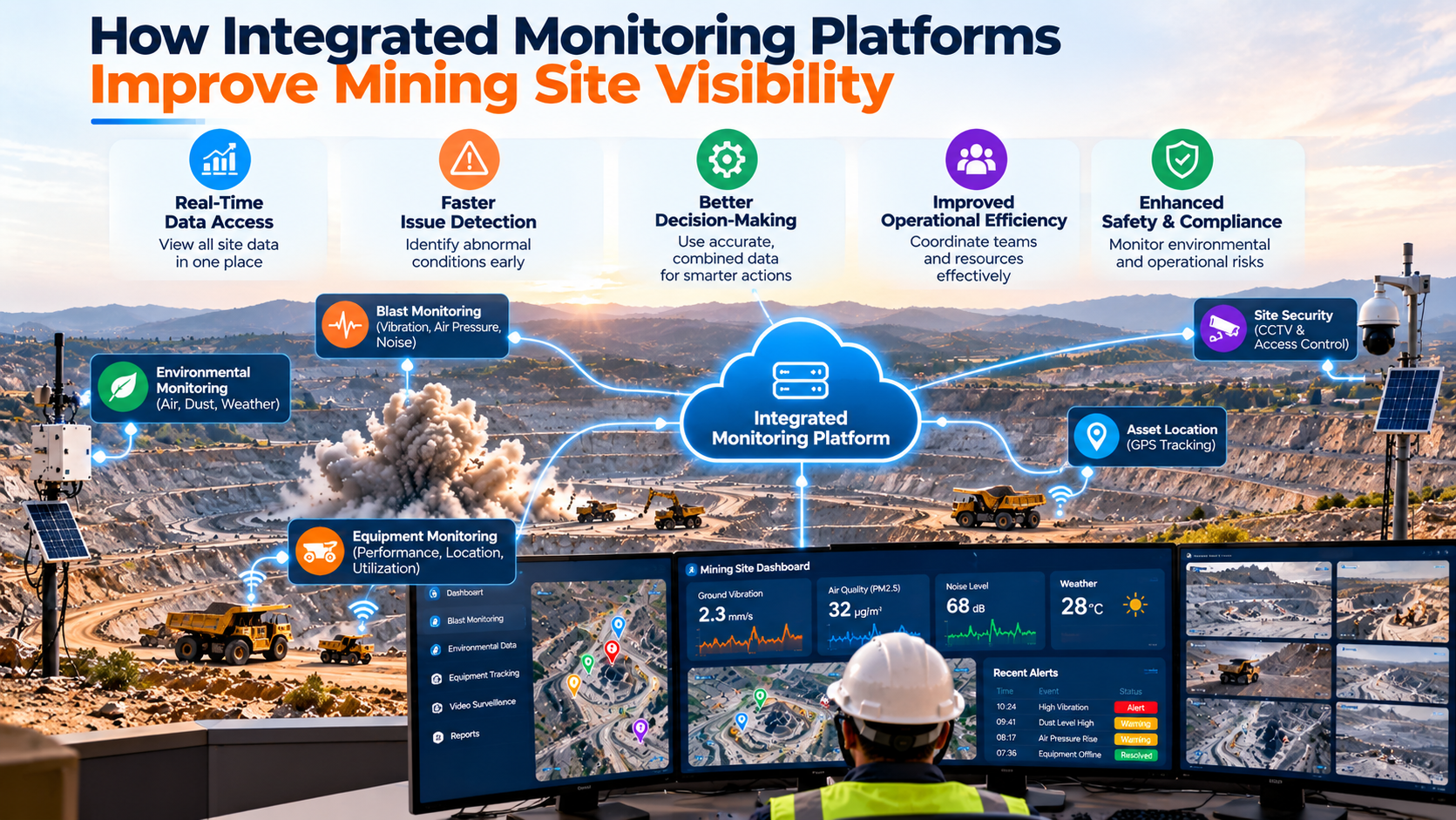
This guide explains how integrated monitoring platforms improve mining site visibility — how a centralised monitoring platform works, why it eliminates blind spots, and what a unified dashboard delivers. It builds on how data travels from sensor to dashboard.
▶ Watch: Real-Time IoT Monitoring in Action
Table of Contents
- The problem with separate systems
- What is an integrated monitoring platform?
- How it improves visibility
- Separate vs integrated
- Key benefits
- What to look for
- FAQs and conclusion
The Problem with Separate Monitoring Systems
As mines have adopted more monitoring, they have often ended up with a patchwork of separate tools. Each monitoring system does its job well, but none talks to the others. The result is fragmentation: data lives in silos, and no one has a complete, real-time view of the whole site. On a large open pit, where activity is spread over a vast area, this lack of unified site monitoring is especially risky.
This creates dangerous blind spots. A problem developing in one area may go unnoticed because the person watching another system cannot see it. Correlating events — did that vibration spike coincide with a dust event? — means manually cross-checking several tools. At best this is slow and frustrating; at worst, it means a risk is missed entirely because no one was looking at the right screen.
What Is an Integrated Monitoring Platform?
An integrated monitoring platform brings data from all of a site’s monitoring systems into a single, centralised system — a single pane of glass. Instead of many separate monitoring dashboard screens, a unified monitoring tool brings centralized monitoring of blast, environmental, equipment, and other data into one place, giving one complete view of the site.
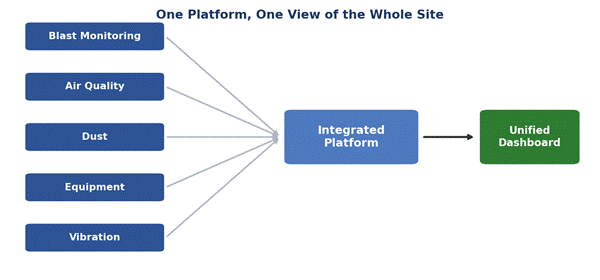
Rather than replacing the individual sensors, the platform unifies their data. Blast vibration, air quality, dust, and environmental monitoring all feed into one unified dashboard, so the full picture is visible at a glance — the foundation of real site-wide awareness.
How Integrated Platforms Improve Site Visibility
The core benefit is exactly what the name suggests: it helps enhance visibility across the whole operation. With everything in one centralised monitoring view, a manager can see the entire site’s status at a glance, in real time, without switching between tools.
This high visibility eliminates blind spots. Because all data sits together, it is easy to correlate events across systems — to see that a vibration reading, an air quality change, and an equipment alert are connected. Patterns that were invisible when data was siloed become obvious. The result is faster, better-informed decisions and far fewer surprises, improving both site safety and efficiency.
Separate Systems vs an Integrated Platform
The difference between juggling separate tools and using one integrated platform is stark:
| Aspect | Separate systems | Integrated platform |
| View | Many screens and logins | One single pane of glass |
| Data | Scattered and siloed | Unified and centralised |
| Blind spots | Common, between systems | Eliminated |
| Data review | Slow, manual cross-checking | Fast, in one place |
| Response | Delayed | Immediate, with full context |
The same principle that makes remote monitoring across multiple sites so powerful applies within a single site: one unified view beats many scattered ones.
The Key Benefits of an Integrated Monitoring Platform
Bringing all monitoring into one platform delivers benefits across the operation:
- Complete visibility: the whole site on one single pane of glass, in real time.
- No blind spots: nothing falls between separate systems unnoticed.
- Faster data review: all data in one place, easy to analyse and correlate.
- Better site safety: risks are seen and addressed quickly, with full context.
- Improved user experience: one simple interface instead of many complex tools.
- Smarter decisions: a complete picture supports better long-term planning.
Combined with automated alerts and the shift from manual to real-time monitoring, an integrated platform helps ensure maximum visibility and control across the site.
What to Look for in an Integrated Platform
Not every platform is equal, so a few things matter when choosing one. Look for broad integration — the ability to bring in data from all your existing monitoring systems, whatever their source. Prioritise a clear, intuitive unified dashboard, because a platform is only useful if people can read it at a glance. Ensure it offers real-time data and alerts, not just historical data review, and strong data management so information is stored securely and is easy to retrieve. Finally, choose a platform that scales as you add systems or sites, so it supports you over the long term.
Conclusion
Integrated monitoring platforms transform mining site visibility by replacing a patchwork of separate systems with one unified view. By bringing all monitoring data onto a single pane of glass, they eliminate blind spots, speed up data review, and give managers the complete, real-time picture needed to run a safe, efficient site.
As mines deploy ever more monitoring, integration is what keeps it all usable. Explore our related guides on remote blast monitoring and how IoT is changing mining monitoring to see unified visibility in action.
Unify Your Monitoring with Brilliant Info Systems
Brilliant Info Systems delivers integrated, IoT-powered monitoring that brings every system into one view — from a complete blast vibration monitoring solution to IoT and smart sensors. Contact our team to improve visibility across your entire mining site.
Frequently Asked Questions
What is an integrated monitoring platform?
It is a centralised system that brings data from all of a site’s separate monitoring systems — blast, air quality, dust, equipment, and more — into one unified dashboard, giving a single, complete view of the whole site.
How does an integrated platform improve mining site visibility?
By unifying all monitoring data in one single pane of glass, it lets managers see the entire site in real time, eliminates blind spots between systems, and makes it easy to correlate events for faster, better decisions.
What is a single pane of glass in monitoring?
A single pane of glass is one unified dashboard that displays data from many separate systems together, so users see everything in one place rather than switching between multiple tools and screens.
Does an integrated platform replace existing monitoring systems?
No. It unifies the data from your existing sensors and systems rather than replacing them, bringing their outputs together into one centralised view without discarding the monitoring you already have.
How does integration improve site safety?
By removing blind spots and showing all data together in real time, it ensures risks are seen and addressed quickly, with full context — rather than being missed because no one was watching the right separate screen.
What should I look for in a monitoring platform?
Look for broad integration with your existing systems, a clear unified dashboard, real-time data and alerts, strong data management, and the ability to scale over the long term as your site grows.