
Why Historical Blast Data Is Valuable for Future Blast Planning
Every blast a mine fires teaches a lesson — about the rock, the design, and the result. But too often that lesson is lost. The data is recorded for compliance, filed away, and never looked at again. Yet within those blast records lies a goldmine of information for planning better blasts. Historical blast data, used well, is one of the most valuable tools a mining operation has for making every future blast safer, cheaper, and more effective.
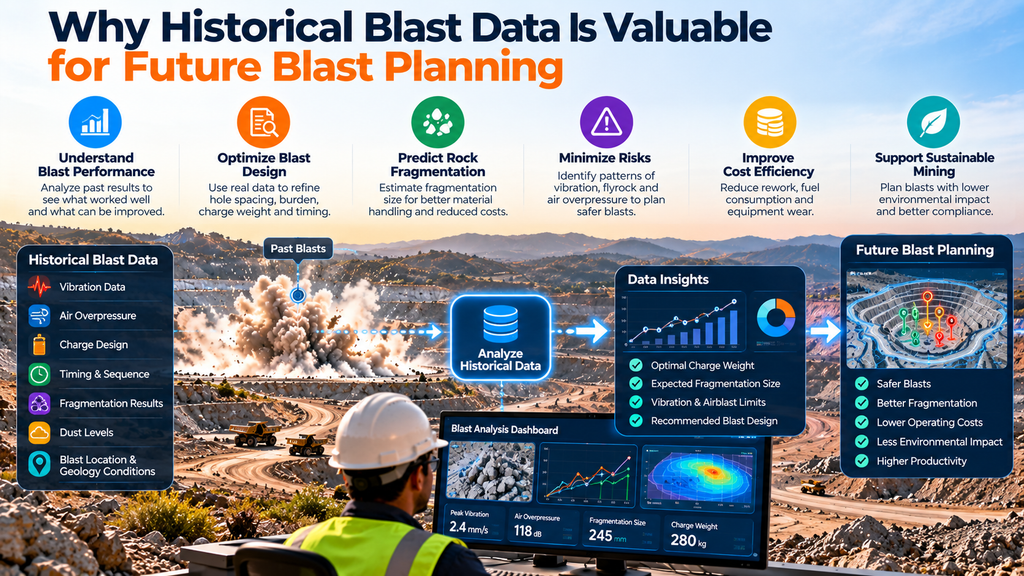
This guide explains why historical blast data is valuable for future blast planning — how blast data analysis reveals performance trends, and how those insights drive blast design optimization. It builds on our guide to how blast monitoring data supports better decision-making.
▶ Watch: Real-Time IoT Monitoring in Action
Table of Contents
- What is historical blast data?
- Why most data goes to waste
- What historical data reveals
- The blast planning feedback loop
- Optimizing blast design
- Reducing vibration and cost
- Best practices
- FAQs and conclusion
What Is Historical Blast Data?
Historical blast data is the accumulated record of every blast an operation has fired — the design used, the charge and timing, and the results measured, from ground vibration and air overpressure to fragmentation. Captured through blast monitoring sensors and stored over time, it builds a detailed history of how the operation’s blasting behaves.
Each individual blast record is useful on its own, but the real value comes from the collection. Hundreds of blast records together reveal patterns that no single blast can — the foundation of serious blast data analysis and planning.
Why Most Blast Data Goes to Waste
In many operations, blast data is treated as a compliance formality. It is recorded to prove a blast stayed within limits, then archived and forgotten. The data that could reveal how to blast better sits unused, and every new blast is planned largely from experience and intuition rather than evidence.
This is a missed opportunity. The same data already being captured for compliance contains the answers to questions every blasting team asks: which designs give the best fragmentation, which keep vibration lowest, and which cause the fewest problems across blasting operations. Putting historical data to work is often the cheapest performance improvement available, because the data already exists.
What Historical Blast Data Reveals
Analysed across many blasts, historical data reveals patterns that transform planning:
| What historical data reveals | Why it helps future planning |
| Blast performance trends | Shows which designs consistently work best |
| Vibration patterns | Identifies designs that keep vibration low |
| Fragmentation results | Links blast design to size distribution |
| Ground response | Shows how different areas behave |
| Recurring problems | Flags issues to avoid repeating |
Most valuable of all are blast performance trends — seeing, over time, which approaches consistently deliver the best results in your specific ground conditions, whether in an open pit or underground. This is knowledge that only accumulates with history.
The Blast Planning Feedback Loop
Historical data turns blast planning into a continuous improvement loop. Each blast is recorded, the data is analysed for trends, the best-performing designs are identified, and those insights shape the plan for the next blast — which is then recorded in turn.
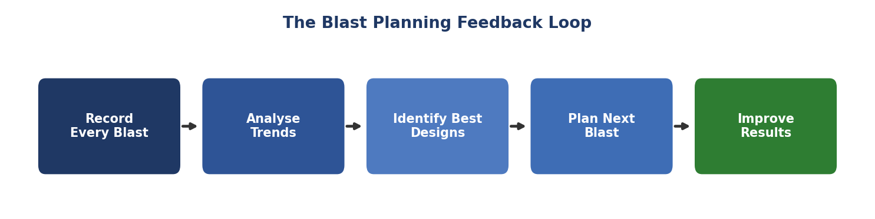
With every cycle, the operation learns. Blast planning stops being a repeat of what was done last time and becomes a steadily improving process, guided by evidence from hundreds of previous blasts. This feedback loop is the core reason historical data is so valuable for planning.
Optimizing Blast Design with Historical Data
The clearest payoff is blast design optimization. By comparing the designs and results of past blasts, engineers can see exactly which charge sizes, delays, patterns, and drilling layouts produced the best outcomes. Instead of guessing, they base each new design on what has demonstrably worked before.
This matters across the whole drilling and blasting process. Historical data shows how to achieve the target fragmentation and size distribution with less explosive, how to control the size of blast fragments and reduce oversize and fines, and how to adapt the design to different areas of the site. Over time, optimizing blast design from data delivers better fragmentation, smoother downstream processing, and lower cost per tonne.
Reducing Vibration, Cost and Risk
Historical data also makes blasting safer and cheaper. By revealing which designs keep ground vibration lowest for the same result, it helps plan blasts that protect nearby structures — a key part of minimizing damage to surroundings. And by identifying the most efficient designs, it reduces wasted explosive and rework.
Across multiple sites, this value multiplies. A design proven to work at one location can inform planning at another, as remote monitoring across multiple sites brings all the data together. The more history an operation accumulates, the better its future planning becomes.
Best Practices for Using Historical Blast Data
To unlock this value, a few practices help. Record every blast completely and accurately, because gaps weaken the analysis. Store the data in one accessible place rather than scattered files, so it can actually be reviewed. Analyse it regularly for trends, not just when a problem arises. Link design details to results, so you can see which choices caused which outcomes. And feed the insights directly into planning the next blast. Treated this way, historical data becomes a living asset that keeps making your blasting better.
Conclusion
Historical blast data is far more than a compliance archive — it is a record of hard-won lessons that can make every future blast better. By analysing blast records for performance trends and feeding those insights into blast design optimization, operations turn their own history into a powerful planning tool.
The data is already being captured; the opportunity is simply to use it. Explore our related guides on how blast monitoring data supports better decision-making and how IoT is changing blast monitoring to put your blast history to work.
Put Your Blast History to Work with Brilliant Info Systems
Brilliant Info Systems delivers a complete blast vibration monitoring solution that captures, stores, and analyses every blast — turning historical data into better planning. Data travels from sensor to dashboard and into insight. Contact our team to make your blast history a planning advantage.
Frequently Asked Questions
Why is historical blast data valuable for future planning?
Because it reveals which blast designs consistently deliver the best results in your ground conditions. Analysing past blast records lets you plan each new blast from evidence rather than guesswork, improving safety, fragmentation, and cost.
What does historical blast data include?
It includes the record of every blast — the design, charge, and timing used, plus the measured results such as ground vibration, air overpressure, and fragmentation — accumulated over time into a detailed performance history.
How does historical data help optimize blast design?
By comparing the designs and results of past blasts, engineers can identify which charge sizes, delays, and patterns produced the best fragmentation and lowest vibration, then base new designs on what has demonstrably worked.
What are blast performance trends?
Blast performance trends are the patterns that emerge when many blasts are analysed together — showing, over time, which approaches consistently deliver the best results in a given site’s conditions.
How does historical data reduce blasting cost?
By revealing the most efficient designs, it helps achieve target fragmentation with less explosive and less rework, lowering cost per tonne while improving downstream processing.
How should historical blast data be stored?
It should be recorded completely and kept in one accessible, centralised place rather than scattered files, so it can be analysed for trends and fed into future blast planning.