
The Role of Environmental Monitoring in Sustainable Mining Operations
Mining extracts the natural resources that modern life depends on, but it also carries significant environmental and social responsibilities. Today, investors, regulators, and communities expect mining to be socially and environmentally responsible — and to prove it. This is the heart of ESG — environmental social and governance — in mining, and environmental monitoring is one of the most practical tools for delivering it.
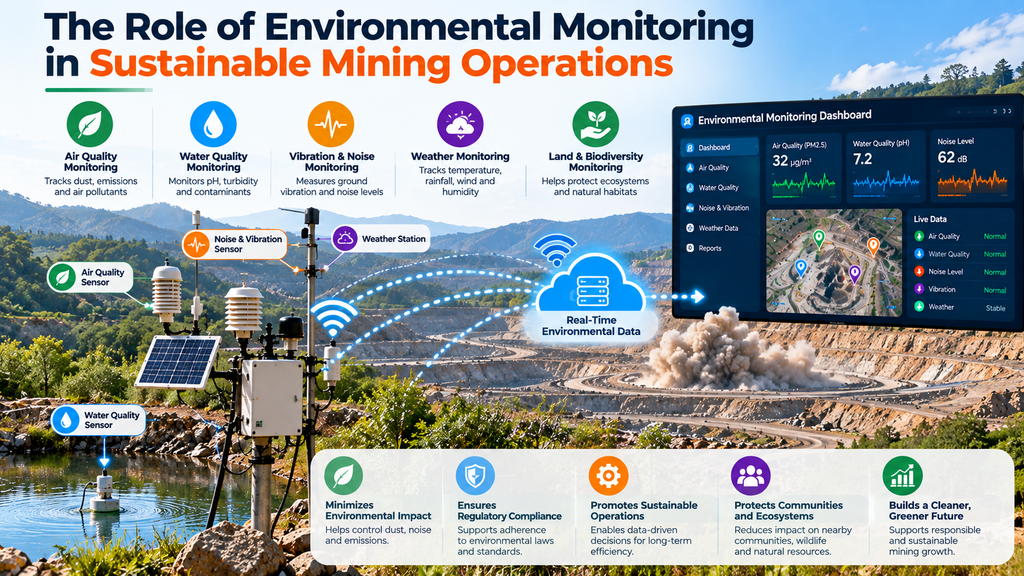
This article explains the role of environmental monitoring in sustainable mining operations — how it supports ESG, responsible mining practices, and real environmental protection. It builds on our guide to environmental sensors in mining.
▶ Watch: Real-Time IoT Monitoring in Action
Why Sustainable Mining Matters
Sustainable mining means extracting minerals in a way that protects the environment, supports communities, and meets the needs of today without harming future generations — directly supporting the United Nations Sustainable Development Goals (SDGs). As environmental regulations tighten and scrutiny grows, sustainable mining practices have shifted from optional to essential.
At the centre of this shift is ESG — environmental, social and governance performance. Increasingly, a mine’s access to finance, permits, and community support depends on demonstrating strong ESG credentials, and that demands reliable data on its environmental and social impact.
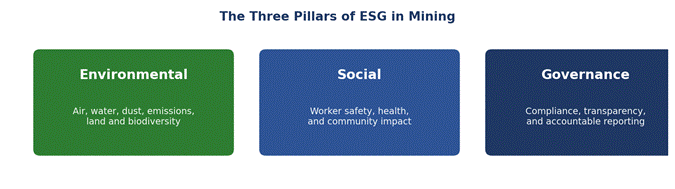
How Environmental Monitoring Supports ESG
Environmental monitoring provides the continuous, objective data that underpins all three pillars of ESG. Rather than relying on estimates or occasional checks, a mine can measure its actual impact in real time:
| ESG pillar | How environmental monitoring helps |
| Environmental | Tracks air, water, dust, and emissions to limit environmental impacts |
| Social | Protects worker health and nearby communities with real-time data |
| Governance | Provides verifiable records to ensure compliance and transparency |
From dust monitoring to air quality, water, and emissions, continuous monitoring turns sustainability from a statement into measurable performance.
Managing Environmental Impacts
The most direct contribution of monitoring is managing a mine’s environmental impacts. Sensors track air quality, dust, water quality, noise, and vibration continuously, catching problems early — before they harm the environment or the community. This supports better environmental management and helps reduce the footprint of operations, from mineral exploration through to extraction and rehabilitation.
Monitoring also supports efforts to reduce greenhouse gas emissions and integrate renewable energy sources, by measuring energy use and emissions so improvements can be tracked and proven. What gets measured gets managed — and monitoring provides the measurement.
Ensuring Compliance and Reducing ESG Risk
Environmental regulations are strict and getting stricter, and failing to comply carries heavy financial and reputational cost. Continuous monitoring provides an unbroken, verifiable record that helps ensure compliance at all times, not just on inspection day. This same data reduces ESG risk — the risk of incidents, fines, and lost community trust that can threaten a mine’s licence to operate.
By demonstrating responsible performance with hard data, a mine strengthens its standing with regulators, investors, and the communities around it — turning environmental and social responsibility into a genuine business advantage.
Conclusion
Environmental monitoring is far more than a compliance exercise — it is a cornerstone of sustainable, responsible mining. By measuring a mine’s real impact continuously, it enables better environmental management, ensures compliance, protects communities, and provides the evidence that strong ESG performance demands.
As the industry moves toward more sustainable development, monitoring is what turns good intentions into measurable results. Explore our guides on continuous environmental monitoring and how IoT is changing environmental monitoring to see sustainable mining in action.
Build Sustainable Mining with Brilliant Info Systems
Brilliant Info Systems delivers IoT-powered environmental monitoring for sustainable, responsible mining — from IoT and smart sensors to a complete blast vibration monitoring solution. Contact our team to support your ESG and sustainability goals with real environmental data.
Frequently Asked Questions
What is the role of environmental monitoring in sustainable mining?
Environmental monitoring provides continuous, objective data on a mine’s air, water, dust, and emissions, enabling it to manage its impact, ensure compliance, and demonstrate the ESG performance that sustainable mining requires.
How does environmental monitoring support ESG in mining?
It underpins all three ESG pillars: environmental, by tracking impacts; social, by protecting workers and communities; and governance, by providing verifiable records for compliance and transparent reporting.
What does environmental monitoring measure in mining?
It measures air quality, dust, water quality, noise, vibration, and emissions across a site, giving a complete, real-time picture of a mine’s environmental impact.
How does monitoring help with sustainable mining practices?
By catching problems early and measuring performance continuously, it helps mines reduce their footprint, ensure compliance with environmental regulations, and prove progress toward sustainability goals and the SDGs.
Why is ESG important in mining?
ESG performance increasingly determines a mine’s access to finance, permits, and community support. Strong, data-backed environmental and social performance reduces risk and protects the licence to operate.