
How Blast Monitoring Can Help Minimize Damage to Nearby Structures
For mines and quarries operating near homes, roads, or heritage buildings, one worry looms above the rest: could our blasting damage the structures nearby? It is a legitimate concern. The ground vibration and air overpressure from a blast travel outward and can, if uncontrolled, crack walls, unsettle foundations, and trigger costly disputes. Yet blasting remains essential to moving rock. The answer is not to stop blasting, but to control and prove its impact — and that is exactly what blast monitoring does.
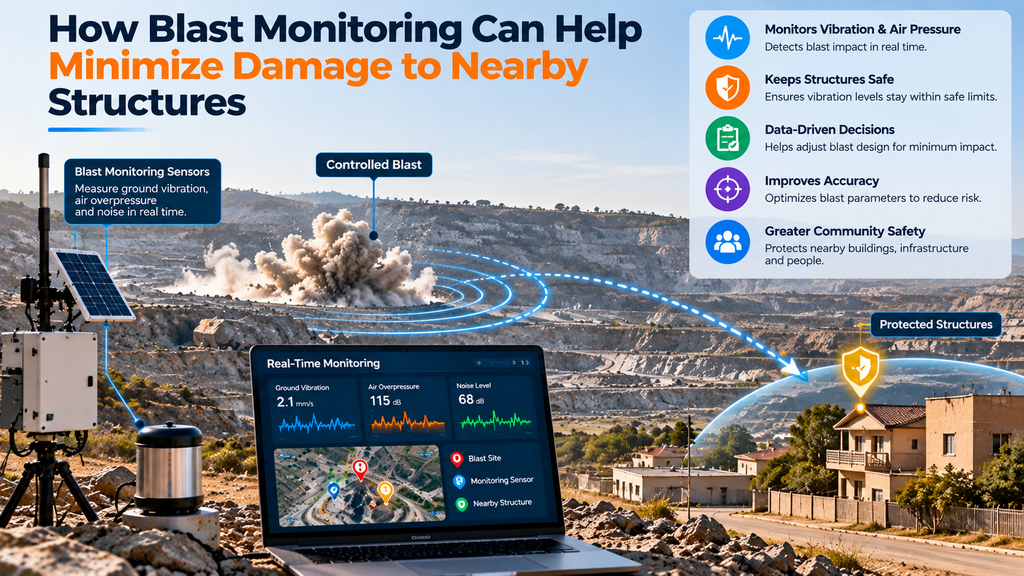
This guide explains how blast monitoring can help minimize damage to nearby structures — how vibration causes damage, how monitoring keeps it within safe limits, and how the data protects both buildings and the operation itself. It is the core purpose of a modern blast vibration monitoring solution.
▶ Watch: Real-Time IoT Monitoring in Action
Table of Contents
- How blasting can damage structures
- What causes blast damage
- Types of structural damage
- How monitoring minimizes damage
- Vibration limits and standards
- Pre-blast and post-blast surveys
- Real-time protection
- Improving blast design
- Protecting against disputes
- Best practices
- FAQs and conclusion
How Blasting Can Damage Nearby Structures
When explosives detonate, only some of their energy breaks rock. The rest radiates outward as ground vibration and an air pressure wave. When these reach a building, they make it shake and flex, however slightly. Most of the time the effect is harmless, but if the vibration is strong enough — or the building is fragile enough — it can cause damage, from hairline cracks to more serious structural harm.
The key insight is that damage depends on the intensity of the vibration reaching the structure, not the size of the blast alone. A large blast far away may be harmless, while a smaller one close to a fragile building could cause problems. This is why measuring the vibration at the structure — not just at the blast — is the foundation of protecting nearby buildings.
Why Protecting Nearby Structures Matters More Than Ever
The pressure to prevent blast damage has never been higher. As towns and infrastructure expand, mines and quarries that were once isolated now operate close to homes, schools, roads, and pipelines. Every blast is felt by more people, and communities are far less tolerant of vibration and noise than they once were. A single incident of damage — or even the perception of it — can escalate into complaints, regulatory action, and reputational harm.
At the same time, regulators have tightened the limits and the evidence they expect. It is no longer enough to blast carefully and hope for the best; operators must demonstrate, with data, that every blast stayed within safe limits for the structures around them. This combination of closer neighbours and stricter oversight is exactly why systematic blast monitoring has moved from a nice-to-have to an operational necessity for any site near sensitive structures.
What Causes Blast Damage?
Several factors determine whether a blast will damage a nearby structure. Understanding them shows why monitoring and control matter so much:
| Factor | How it affects damage risk |
| Charge size | Larger charges produce stronger vibration |
| Distance to structure | Closer structures feel stronger vibration |
| Blast design & timing | Good delays reduce peak vibration |
| Ground conditions | Rock and soil change how vibration travels |
| Structure type | Older or weaker buildings are more vulnerable |
| Frequency | Low frequencies are more damaging to buildings |
Of these, vibration intensity and frequency are the most important, which is why they are measured directly. The key metric is peak particle velocity (PPV) — how fast the ground moves — read alongside frequency, because low-frequency vibration is more likely to resonate with and damage a building.
Types of Structural Damage
Not all blast-related damage is the same. Distinguishing the levels helps set sensible limits and respond to complaints fairly:
| Damage level | What it looks like |
| Cosmetic | Hairline cracks in plaster or paint |
| Minor | Cracks in walls, loosened fittings |
| Structural | Damage affecting the building’s integrity |
| Perceived (not real) | Complaints where no actual damage occurred |
Importantly, many complaints relate to perceived rather than actual damage — a resident feels a blast and assumes it caused a pre-existing crack. This is where objective monitoring data becomes invaluable, separating real damage from perception with hard evidence.
Frequency, Resonance and Why Both Matter
It is tempting to think of vibration intensity as the whole story, but frequency matters just as much when it comes to damage. Every building has a natural frequency at which it flexes most easily. When blast vibration arrives at or near that frequency, the structure resonates — amplifying the movement much as a pushed swing goes higher when timed right. The same vibration intensity can therefore be harmless at a high frequency and damaging at a low one.
This is why good monitoring records both peak particle velocity and the frequencies present in each blast, and why standards define safe limits as a combination of the two. Low-frequency vibration, common at greater distances from a blast, is the most dangerous for typical buildings because it sits closest to their natural frequencies. Understanding this relationship is central to setting limits that genuinely protect structures rather than simply capping a single number.
How Blast Monitoring Minimizes Damage
Blast monitoring protects nearby structures through a simple but powerful loop: set safe limits, measure every blast against them, and act when needed. Sensors placed at the most sensitive structures measure the ground vibration and air overpressure each blast produces, and the system compares those readings against the limits proven safe for those buildings.
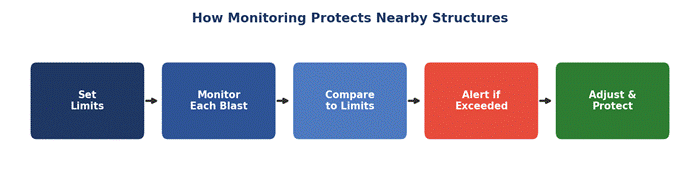
If a blast approaches or exceeds a limit, the operator knows immediately and can adjust the next blast before any harm is done. Over time, this keeps every blast within safe bounds — turning damage prevention from a hope into a measured, managed certainty. The monitoring does not stop the vibration, but it ensures the vibration never reaches damaging levels.
Vibration Limits and Standards
The whole approach rests on knowing what level of vibration a structure can safely withstand. These limits are defined by standards and regulations, set in terms of PPV and frequency, with lower limits for older, weaker, or heritage structures than for robust modern ones. Working to the correct limit for each nearby building is essential.
Because damage depends on both velocity and frequency, good standards define safe limits as a combination of the two rather than a single number. Monitoring against these established, evidence-based limits is what gives operators confidence that a blast which stays within them will not cause damage — and gives regulators and residents confidence too.
Balancing Charge Weight and Distance
One of the most useful concepts in controlling blast damage is the relationship between charge weight and distance, often expressed as scaled distance. In simple terms, the vibration a structure feels grows with the amount of explosive detonated at once and shrinks with distance from the blast. By managing these two variables together, engineers can keep vibration at nearby structures within safe limits even as blasting continues.
In practice, this means limiting the amount of explosive fired in any single instant — using delays to break a large blast into many smaller, timed detonations — so that no single moment sends excessive vibration toward a building. Monitoring data confirms whether these controls are working: if readings at a structure are higher than expected, the charge per delay can be reduced or the timing refined. This data-guided balancing of charge and distance is one of the most effective tools for protecting structures without halting production.
Pre-Blast and Post-Blast Surveys
Two surveys bookend good damage protection. A pre-blast survey documents the condition of nearby structures before blasting begins — photographing existing cracks and recording a baseline. This baseline is crucial: without it, there is no way to prove whether a crack existed before a blast or appeared after it.
A post-blast survey then checks the same structures after blasting, comparing them to the baseline. Together with the vibration data recorded for each blast, these surveys provide a complete, defensible picture: what condition the building was in, what vibration it experienced, and whether anything actually changed. This combination is the strongest protection against both real damage and unfounded claims.
Real-Time Protection for Nearby Structures
The most powerful damage-prevention capability is real-time monitoring. When vibration data is available the instant a blast fires, an exceedance is caught immediately — not discovered days later when the damage may already be done. This is why real-time blast monitoring is critical for protecting nearby structures.
With real-time alerts, an operator who sees a blast approaching the limit can immediately review and adjust the next blast’s design, charge, or timing. The data travels from sensor to dashboard in seconds, so protective action happens before, not after, harm occurs. For sites near sensitive buildings, this immediacy is the difference between preventing damage and merely documenting it.
Monitoring the Right Structures
Effective damage prevention depends on measuring vibration where it actually matters — at the structures being protected, not just near the blast. A sensor placed at the blast tells you how strong the blast was; a sensor placed at the nearest home tells you what that home experienced, which is the number that determines damage and compliance. Correct sensor placement is therefore fundamental.
For sites with several sensitive structures at different distances and directions, this often means monitoring multiple locations at once. The nearest building is not always the most vulnerable — an older structure further away may have lower safe limits than a robust one nearby. Mapping the structures around a site, understanding each one’s vulnerability, and placing monitors accordingly ensures that the most at-risk buildings are always the ones being watched. This targeted approach is far more protective than a single, general-purpose monitor.
Using Data to Improve Blast Design
Beyond preventing individual incidents, monitoring data helps eliminate damage risk at the source by improving blast design. By analysing blast data across many events, engineers learn which charge sizes, delays, and patterns produce the least vibration at nearby structures for the same rock-breaking result.
This means each blast can be designed to be inherently gentler on surroundings while still doing its job. Over time, a mine can systematically reduce the vibration its blasting sends toward nearby buildings — protecting structures not just by staying under limits, but by lowering the impact in the first place. It is damage prevention built into the blast itself.
Protecting the Operation Against Disputes
Damage protection is not only about the buildings — it is about protecting the operation from the serious consequences of a damage claim. A single dispute, whether justified or not, can halt blasting, incur legal costs, and damage community relations. Monitoring data is the operator’s best defence.
When a complaint arises, an operator with complete monitoring records can show exactly what vibration each blast produced and that it stayed within safe limits. This objective evidence resolves most disputes quickly and fairly, distinguishing genuine damage from coincidence. Without such data, an operator is left arguing perception against perception — a position that often ends in costly settlements or shutdowns regardless of the truth.
Best Practices for Minimizing Blast Damage
To protect nearby structures effectively, a few practices are essential. Place monitors at the nearest and most vulnerable buildings, not just near the blast. Know and work to the correct vibration limits for each structure type. Conduct pre-blast and post-blast surveys to establish and verify baselines. Use real-time monitoring so exceedances are caught instantly. Record every blast, building a complete history. And use the accumulated data to refine blast design, steadily lowering the impact over time. Together, these turn damage protection from reactive damage control into proactive prevention.
A Real-World Example
Consider a quarry that expanded operations toward a village on its boundary. Residents began raising concerns that blasting was cracking their homes, and without data the quarry had no way to respond except to apologise and worry. Faced with a possible shutdown, it installed monitors at the nearest and most vulnerable houses and began recording the vibration and air overpressure of every blast.
The data told a clear story. Almost every blast was comfortably within safe limits, and the cracks residents pointed to pre-dated the expansion, as pre-blast surveys confirmed. Where one or two blasts had crept higher, the quarry adjusted its charge-per-delay and brought the readings down. Armed with objective evidence, it could reassure the community with facts, resolve complaints fairly, and continue operating — while genuinely reducing its impact on the village. Without monitoring, the same situation could easily have ended in a costly shutdown based on perception alone.
Conclusion
Blasting near structures need not mean damaging them. By measuring the vibration and air overpressure every blast produces, comparing it against safe limits, and acting the instant a limit is approached, blast monitoring keeps nearby buildings protected. Combined with pre- and post-blast surveys and improving blast design, it turns damage prevention into a measured, provable process.
Just as importantly, monitoring protects the operation itself — providing the evidence to resolve disputes and keep blasting. Explore our related guides on blast monitoring sensors and remote blast monitoring to see how structure protection works across an operation.
Protect Nearby Structures with Brilliant Info Systems
Brilliant Info Systems delivers a complete blast vibration monitoring solution that protects nearby structures — real-time, accurate, and defensible — powered by IoT and smart sensors. Contact our team to minimize blast damage and protect the buildings around your site.
Frequently Asked Questions
How does blast monitoring help minimize damage to nearby structures?
It measures the vibration and air overpressure each blast produces at nearby structures and compares them against safe limits, alerting operators to adjust before any blast reaches a level that could cause damage.
What causes blast damage to buildings?
Damage depends on vibration intensity and frequency reaching the structure — influenced by charge size, distance, blast design, ground conditions, and the building’s own vulnerability. Low-frequency, high-velocity vibration is the most damaging.
What is PPV and why does it matter?
PPV, or peak particle velocity, measures how fast the ground moves during a blast. It is the key indicator of damage potential and the basis of most vibration limits, read alongside frequency.
What are pre-blast and post-blast surveys?
A pre-blast survey documents a structure’s condition before blasting begins, establishing a baseline; a post-blast survey checks it afterward. Together with vibration data, they prove whether a blast actually caused any change.
How does real-time monitoring protect structures?
It flags an exceedance the instant it happens, so operators can adjust the next blast before damage occurs — rather than discovering a problem days later when it is too late to prevent.
Can monitoring data help with damage complaints?
Yes. Complete monitoring records show exactly what vibration each blast produced, providing objective evidence to resolve complaints fairly and distinguish genuine damage from perception or pre-existing conditions.