
What Is Barcode Technology? A Complete Guide
You see them hundreds of times a week — on cereal boxes, parcels, boarding passes, and warehouse shelves. The humble barcode is one of the most widely used pieces of technology on the planet, quietly powering everything from the grocery store checkout to global supply chains. Yet most people never stop to think about how it actually works.
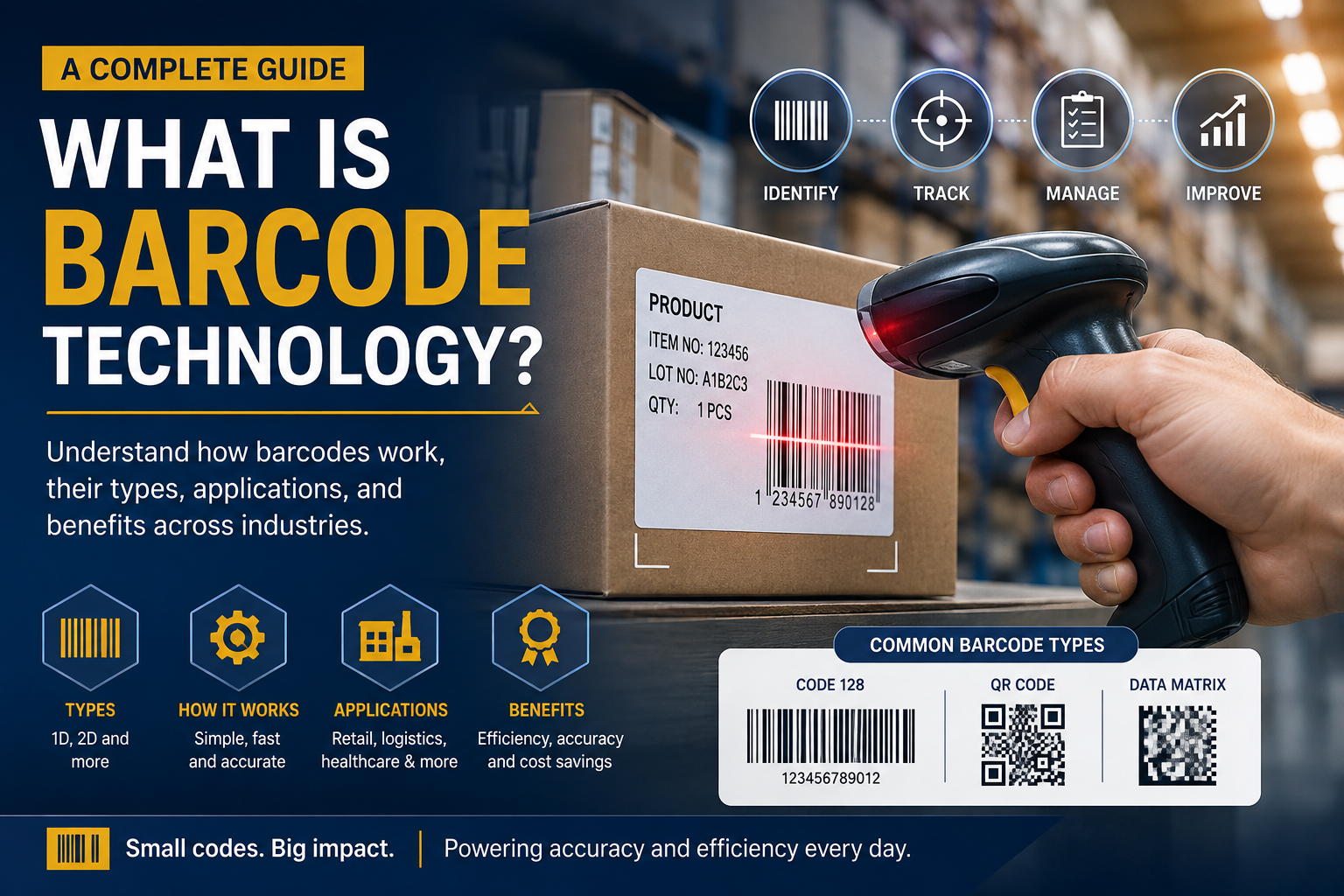
Barcode technology turns a simple printed pattern into fast, accurate data capture, replacing slow manual typing and the human error that comes with it. This complete guide explains what barcode technology is, how it works, the different types of barcodes and scanners, where it is used, and how it compares with newer options like RFID.
▶ Watch: Warehouse Management System (WMS)
Table of Contents
- What is barcode technology?
- How barcodes work
- 1D vs 2D barcodes
- Common barcode types
- Types of barcode scanners
- How barcodes are used
- Benefits and limitations
- Barcode vs RFID
- FAQs and conclusion
What Is Barcode Technology?
A barcode is a machine-readable pattern that represents data as a series of lines, spaces, or squares. Barcode technology is the whole system around it: the printed code, the scanner that reads it, and the software that turns barcode data into useful information. In short, it is a fast, reliable way to identify an item and look it up in a database.
The core idea is simple but powerful. Instead of a worker reading a label and typing a code — slowly, and with the odd mistake — a scanner captures the code in a fraction of a second, every time. That speed and reliability is why barcode systems became the backbone of retail and inventory management worldwide.
A Brief History of the Barcode
The barcode is older than many assume. The idea dates back to the late 1940s, but it took until 1974 for the first retail barcode to be scanned — a pack of chewing gum, marking the start of the Universal Product Code era. From that single scan, barcodes spread rapidly through retail and then into warehousing, manufacturing, and logistics.
What made them so successful was standardisation. Because everyone agreed on common formats like the UPC, a barcode printed by one company could be read by any compatible scanner anywhere — turning the barcode into a truly universal language for identifying products.
How Barcodes Work
Every barcode encodes data in a pattern a scanner can read. In a traditional 1D barcode, information is stored in the widths and spacing of parallel lines. A scanner shines light at the code, measures the reflected pattern, and decodes it into the number or text it represents.
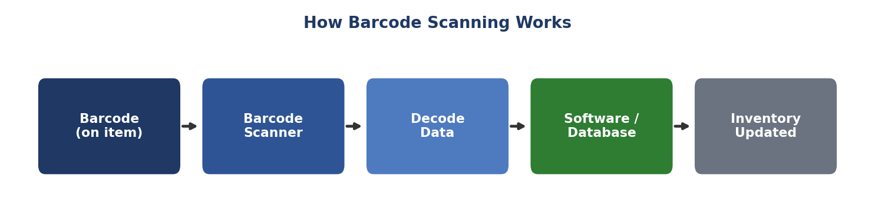
That decoded barcode data is then sent to software — a point-of-sale system, a warehouse management system, or an inventory database — which looks up the item and records the transaction. The whole cycle, from scan to updated record, happens almost instantly, which is what makes barcode scanning so efficient for high-volume data collection.
1D vs 2D Barcodes
Barcodes come in two broad families. Understanding the difference helps you choose the right one for the job.
| Feature | 1D barcodes | 2D barcodes |
| Appearance | Parallel lines | Squares and dot patterns |
| Data capacity | Small (a number or code) | Large (text, URLs, more) |
| Scanning | Laser or linear imager | Camera / 2D imager |
| Examples | UPC, EAN, Code 128 | QR codes, Data Matrix |
| Best for | Simple product IDs | Rich data in a small space |
1D (linear) barcodes are the classic parallel-line codes found on retail products. 2D barcodes, including QR codes and Data Matrix codes, store far more information in a compact square of dots — enough for URLs, batch details, or full product data — and can be read by cameras, including smartphones.
Common Types of Barcodes
Within those two families sit several widely used barcode formats, each suited to a particular job:
| Barcode | Format | Common use |
| UPC | 1D | Retail products at the grocery store checkout |
| EAN | 1D | Retail products internationally |
| Code 39 | 1D | Industrial and logistics labelling |
| Code 128 | 1D | Shipping and supply chain applications |
| QR Code | 2D | Marketing, mobile links, payments |
| Data Matrix | 2D | Small parts, electronics, medical items |
The Universal Product Code (UPC) is the one most people recognise from shop shelves, while 2D formats like QR codes and Data Matrix are increasingly common wherever more data must fit in a small space.
Types of Barcode Scanners
A barcode is only useful if something can read it, and there are several types of barcode scanners for different needs:
- Laser scanners: read 1D barcodes quickly and accurately at a distance; common at checkouts.
- Linear (CCD) imagers: use light sensors to capture 1D codes, durable and reliable.
- 2D area imagers: cameras that read both 1D and 2D barcodes, including QR and Data Matrix codes.
- Handheld and fixed scanners: portable units for staff, or fixed-mount readers on conveyors and checkouts.
- Mobile devices: smartphones and rugged mobile computers that scan codes using their camera.
How Barcodes Are Used in Business
Barcodes appear across almost every industry, but they are especially vital in retail and warehousing. At the grocery store, they speed up checkout and keep prices consistent. In the warehouse, they are used to track inventory at every step — receiving, put-away, picking, and dispatch — feeding accurate data into the warehouse management system.
Beyond retail and logistics, barcodes manage assets, track documents, control access, and label everything from medicines to machine parts. In healthcare they help match the right medication to the right patient; in manufacturing they follow components down the line; in shipping they route millions of parcels every day. Anywhere items need to be identified quickly and accurately, barcode technology tends to be involved.
The Benefits of Barcode Technology
Barcodes have endured for decades because they deliver real, practical value:
- Low cost: barcode labels are extremely cheap to print and apply.
- Speed: scanning is far faster than manual data entry.
- Accuracy: automated data collection sharply reduces human error.
- Simplicity: staff need very little training to scan reliably.
- Universal adoption: suppliers, retailers, and carriers already use compatible barcode systems.
Limitations of Barcodes
Barcodes are not perfect, and knowing their limits helps set expectations. Each code must be scanned individually, within line of sight, which is slower at high volume than technologies that read many items at once. Labels can also smudge, tear, or fade, causing failed reads. And a barcode only records data at the moment it is scanned, so inventory can drift between counts. These limits are exactly where newer technologies come in.
Barcode vs RFID
The most common comparison is barcode versus RFID. Barcodes are simple, cheap, and perfect for individual identification, while RFID reads many tags at once without line of sight and supports real-time tracking. Neither is universally better — they suit different jobs, and many warehouses use both together. For a full breakdown, see our guide on RFID vs barcode, and our explainer on what RFID is and how it works.
How to Implement a Barcode System
Setting up a barcode system is refreshingly straightforward, which is part of its appeal. A sensible rollout follows a few clear steps:
- Choose the right barcode type: a 1D code like UPC or Code 128 for simple IDs, or a 2D code like QR or Data Matrix when you need more data.
- Select suitable scanners: match laser, imager, or mobile devices to how and where your team will scan.
- Generate and print quality labels: clear, durable labels that survive your environment prevent failed reads.
- Integrate with your software: connect scanning to your inventory or warehouse management system so data updates automatically.
- Train staff and test: a short pilot confirms read rates and workflows before you scale.
Because the hardware is inexpensive and widely supported, most businesses can deploy barcodes quickly and see the benefits almost immediately.
The Future of Barcode Technology
Far from fading away, barcodes are evolving. 2D formats like QR codes have exploded thanks to smartphones, adding uses in marketing, payments, and product information. Data Matrix codes are becoming standard for tiny electronics and medical items where space is tight. Barcodes will continue to work alongside RFID and IoT, remaining the cheap, dependable option for straightforward identification for many years to come.
Barcode Best Practices
A few simple habits keep a barcode system running smoothly. Print labels at the right size and resolution so scanners read them first time, and choose label materials that withstand your environment — cold, moisture, or abrasion. Place labels consistently on items so staff know where to aim, and keep a clear quiet zone around each code. Finally, audit read rates now and then; a rise in failed scans usually points to worn labels or a scanner due for attention. These small steps protect the accuracy that makes barcodes worthwhile.
Conclusion
Barcode technology has quietly shaped modern commerce, turning a simple printed pattern into fast, accurate, low-cost data capture. From the grocery store checkout to the warehouse floor, it remains one of the most practical ways to identify items and keep track of inventory.
While newer technologies like RFID add real-time capabilities, barcodes are far from obsolete — they are cheap, universal, and dependable, and often work best alongside those newer options. Understanding how they work helps you choose the right data-capture approach for your business.
Modernise Your Data Capture with Brilliant Info Systems
Brilliant Info Systems helps businesses get the most from barcode and RFID data-capture solutions, integrated with your warehouse management system for accurate, real-time inventory. Talk to our team to design the right identification and tracking approach for your operation.
Frequently Asked Questions
What is barcode technology in simple terms?
Barcode technology is a system that stores data in a machine-readable pattern of lines or squares, which a scanner reads instantly to identify an item and look it up in a database — far faster and more accurately than typing.
What is the difference between 1D and 2D barcodes?
1D barcodes store a small amount of data in parallel lines, like the UPC on retail products. 2D barcodes, such as QR codes and Data Matrix, hold much more data in a square pattern and are read by cameras.
What is a UPC barcode?
The Universal Product Code (UPC) is a common 1D barcode used on retail products worldwide. It identifies the product at checkout and links to its price and details in the store’s system.
What types of barcode scanners are there?
Common types include laser scanners and linear imagers for 1D codes, 2D area imagers for QR and Data Matrix codes, and handheld, fixed, or mobile devices — including smartphones — depending on the use case.
Is barcode better than RFID?
Neither is universally better. Barcodes are cheaper and simpler for individual identification, while RFID reads many items at once for real-time tracking. The right choice depends on volume, speed, and budget, and many operations use both.
Are barcodes still used today?
Very much so. Barcodes remain the standard for retail and inventory identification worldwide, and 2D formats like QR codes are growing fast thanks to smartphones and mobile applications.