
How Blast Monitoring Data Supports Better Decision-Making
Every blast a mine fires produces data — waveforms, peak values, frequencies. For a long time, most of that data did little more than sit in a compliance file, checked once and forgotten. Yet within those numbers lies some of the most valuable information a mining operation has. Used well, blast monitoring data does far more than prove compliance: it drives better decisions across the whole business, from blast design to community relations to investment.
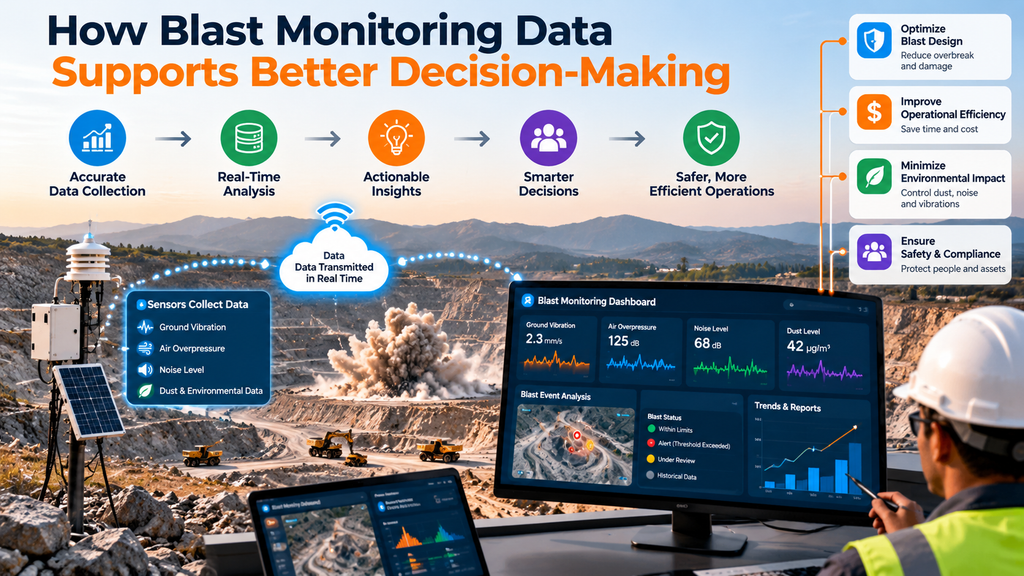
This guide explains how blast monitoring data supports better decision-making — how raw data becomes valuable insights, and how those insights shape smarter, more informed decisions. It is one of the biggest, and most overlooked, benefits of a modern blast vibration monitoring solution.
▶ Watch: Real-Time IoT Monitoring in Action
Table of Contents
- From raw data to decisions
- What blast monitoring data captures
- Turning data into insight
- Where data drives decisions
- Operational and strategic decisions
- The role of data visualisation
- Best practices for data-driven decisions
- FAQs and conclusion
From Raw Data to Better Decisions
Blast monitoring data does not become useful on its own. It travels a path — from raw readings, through management and analysis, to the insights that inform a decision. Understanding that path shows where the value is created:
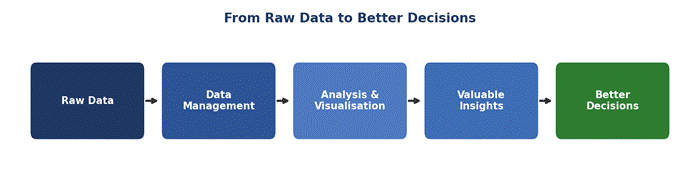
At the start is raw data: the readings from each blast. Good data management organises and stores it reliably. Analysis and data visualisation turn it into a clear picture. That picture yields valuable insights, which finally support better decisions. This decision making process turns numbers into action. Every stage matters — raw data no one can interpret helps no one, and brilliant analysis of inaccurate data misleads.
What Blast Monitoring Data Captures
The foundation of good decisions is accurate data. Blast monitoring captures the key measures of every blast: peak particle velocity (PPV), ground vibration, air overpressure, and the associated frequencies. Captured through reliable blast monitoring sensors and delivered from sensor to dashboard, this data is the raw material for every insight that follows.
The completeness of this data collection matters. Recording every blast, not just a sample, builds the full picture needed to spot patterns and make confident decisions. Partial or inaccurate data leads to partial or wrong conclusions, so the quality of the decision is only ever as good as the quality of the data behind it.
Turning Data into Valuable Insights
Individual blast readings answer a simple question: was this blast within limits? But the real power emerges when data from many blasts is analysed together. Patterns appear — which blast designs produce the least vibration, how ground conditions affect results across blasting operations, and which times or areas see the most complaints in real time.
This is the shift from raw data to valuable insights. Analysis reveals not just what happened, but why, and what to do next. Modern systems apply analytics and even machine learning to surface these insights automatically, turning a growing archive of blast data into a continuously improving knowledge base — the essence of data driven blasting, as explored in how IoT is changing blast monitoring.
Where Blast Monitoring Data Drives Decisions
Good blast data informs decisions across almost every part of a mining operation. A few of the most important areas:
| Decision area | What blast monitoring data informs |
| Blast design | Adjusting charge size, timing, and delays to reduce vibration |
| Compliance | Proving each blast stayed within legal limits |
| Community relations | Answering complaints with objective evidence |
| Operational planning | Scheduling and sequencing blasts safely and efficiently |
| Risk management | Identifying trends before they become problems |
| Investment | Justifying equipment and process changes with data |
From fine-tuning a blast design to justifying investment, the same underlying data serves many decisions — which is why treating it as a strategic asset, not just a compliance record, pays off. It also underpins the safety and control decisions covered in our guide on how blast sensors improve mine safety and operational control.
Operational and Strategic Decisions
Blast monitoring data supports decisions at two levels. Day to day, it drives operational decisions: whether to proceed with the next blast, how to adjust a charge, when to respond to a rising trend. These are the frequent, practical business decisions that keep a site running safely and efficiently, improving operational efficiency one blast at a time.
Over the longer term, the same data informs strategic decisions: which blast designs to standardise across sites, whether to invest in new equipment, how to meet tightening industry standards, and where to focus improvement efforts. By comparing accurate data across many blasts and locations, managers can make strategic decisions grounded in evidence rather than intuition — a decisive advantage as operations grow.
Managing the Data Behind the Decisions
Good decisions depend on good data management. A busy mine generates a large and growing volume of blast data, and if it is scattered across devices, spreadsheets, and inboxes, its value is lost. Centralising it on one platform — organised, secure, and easy to search — is what makes the data usable when a decision needs to be made.
Strong data management also protects the integrity of the record. When blast data is stored securely and consistently, it can be trusted as evidence for regulators and as the basis for strategic decisions. Poor data management, by contrast, leaves an operation unable to find or rely on the very information it needs. In short, the discipline of managing data well is inseparable from the ability to make good, data driven decisions from it.
The Role of Data Visualisation
Data only drives decisions if people can understand it, and this is where data visualisation (data visualization) is essential. A wall of numbers means little to a busy manager; a clear chart showing vibration trending upward, or a simple green-or-red result for each blast, communicates instantly. Good dashboards turn complex waveform data into the relevant data a decision-maker actually needs.
Effective visualisation does two things: it makes the current situation obvious at a glance, and it reveals trends over time that raw numbers hide. By presenting the right information in the right form, visualisation bridges the gap between data and decision — ensuring the insights within the data actually reach the people who act on them.
A Practical Example: Better Blasts Over Time
Consider how this works in practice. A quarry captures accurate data from every blast for a year. Reviewed individually, each blast simply passes or fails its limit. But analysed together, the data reveals something useful: blasts using a particular delay pattern consistently produce lower vibration for the same fragmentation. Armed with that insight, the team standardises the better design across the site.
The result is a measurable improvement — lower vibration, fewer complaints, and steady fragmentation — achieved not by guesswork but by reading the data. Over time, this feedback loop compounds: every blast adds to the knowledge base, and every decision gets a little better informed. That is the quiet power of treating blast monitoring data as a decision-making tool rather than a filing requirement, and it applies to business decisions large and small.
Best Practices for Data-Driven Decisions
To get the most decision-making value from blast monitoring data, a few principles help. Capture complete, accurate data from every blast, because decisions built on gaps are unreliable. Manage the data well, so it is organised, secure, and easy to retrieve. Use visualisation to make insights clear to everyone who needs them, not just specialists. Analyse across many blasts to reveal patterns a single event cannot show. And treat the data as a long-term strategic asset, revisiting it to keep improving blast design and operations. Done consistently, this turns routine monitoring into a genuine competitive advantage.
Conclusion
Blast monitoring data is far more than a compliance formality — it is one of the most valuable decision-making assets a mining operation has. From proving a single blast was safe to shaping the strategic direction of an entire business, well-captured, well-analysed, and well-visualised blast data turns everyday monitoring into better decisions at every level.
The mines that treat this data as a strategic asset, not a filing requirement, gain a real edge. Explore our related guides on remote blast monitoring and why real-time blast monitoring is critical to see data-driven blasting in action.
Turn Blast Data Into Better Decisions with Brilliant Info Systems
Brilliant Info Systems delivers a complete blast vibration monitoring solution with the analytics and dashboards that turn data into decisions — powered by IoT and smart sensors. Contact our team to put your blast monitoring data to work.
Frequently Asked Questions
How does blast monitoring data support decision-making?
It provides accurate, objective data on every blast that, once analysed and visualised, yields insights to guide decisions — from refining blast design and proving compliance to answering complaints and planning investment.
What decisions can blast data inform?
Blast data informs blast design, compliance, community relations, operational planning, risk management, and investment decisions — supporting both day-to-day operational choices and long-term strategic ones.
How is raw blast data turned into insights?
Raw readings are stored and managed, then analysed and visualised — often across many blasts — to reveal patterns and trends. This transforms individual readings into valuable insights that guide action.
Why is data visualisation important?
Because people act on data they can understand. Clear charts and dashboards turn complex waveform data into obvious answers and visible trends, ensuring insights reach and inform the people making decisions.
Why does data accuracy matter for decisions?
Because a decision is only as good as the data behind it. Incomplete or inaccurate data leads to wrong conclusions, so capturing complete, accurate data from every blast is the foundation of good decision-making.
Can blast data improve operational efficiency?
Yes. By revealing which blast designs work best and where problems recur, blast data helps refine operations — improving fragmentation, reducing vibration, and lifting operational efficiency over time.