
Understanding Seismic Sensors Used for Blast Vibration Monitoring
At the heart of every blast vibration monitoring system is a small but crucial device: the seismic sensor. It is the component that actually feels the ground move, turning the invisible energy of a blast into measurable data. Understanding how these sensors work — and which types exist — helps explain how blast monitoring protects structures and proves compliance.
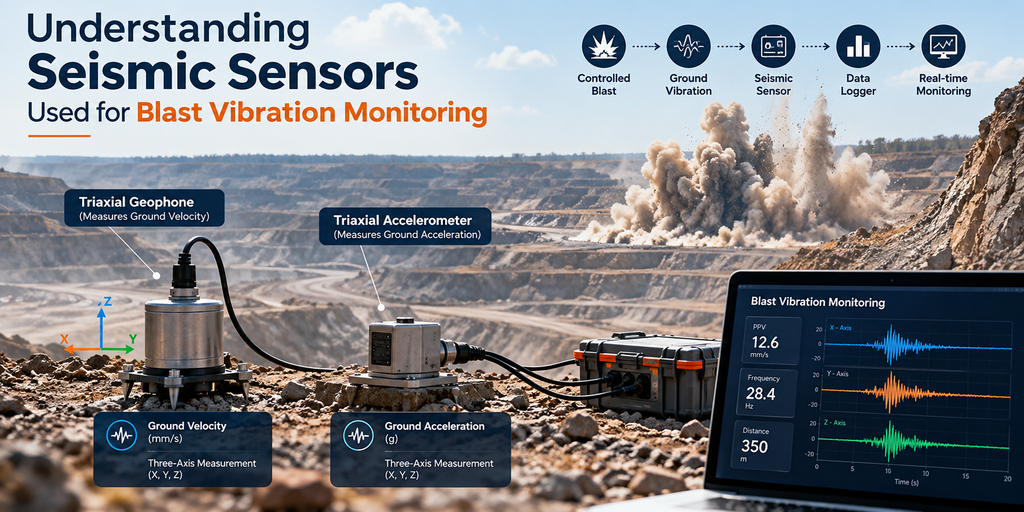
This guide explains the seismic sensors used for blast vibration monitoring: what they are, how a geophone works, the main types, and why they matter. It pairs with our guide to peak particle velocity (PPV), the key value they measure.
▶ Watch: Brilliant Info Systems on YouTube
What Are Seismic Sensors?
Seismic sensors are devices that detect and measure ground vibrations. In blasting, they capture the seismic signals a blast sends through the ground, converting that motion into electrical data a blast seismograph can record. They are the same family of sensors used in earthquake science and geological survey work, adapted for the frequencies and intensities of blasting.
The most common seismic vibration sensor in blast monitoring is the geophone. It measures how fast the ground moves — the particle velocity — which is the basis of the key metric used to judge whether a blast is safe for nearby structures.
How a Geophone Works
A geophone is elegantly simple. Inside is a magnet and a coil, with one free to move relative to the other. When the ground vibrates, the geophone case moves with it while the suspended mass lags behind, and that relative motion generates a small electrical signal proportional to the ground’s velocity.
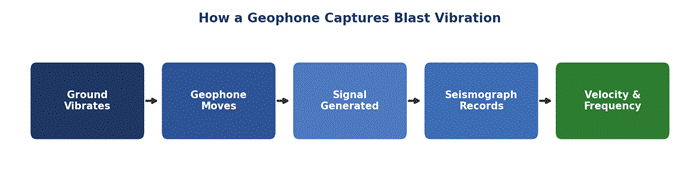
This signal is captured by the seismograph, which records the full waveform and extracts the peak particle velocity and the frequencies present. Because the response happens instantly, geophones provide real time measurement of every blast as it occurs.
Types of Seismic Sensors
There are several types of seismic sensors, each suited to different conditions. Most blast monitoring uses geophones, but the specifics vary:
| Seismic sensor | How it works | Best for |
| Standard geophone | Coil-and-magnet measures ground velocity | General blast vibration monitoring |
| Triaxial geophone | Measures velocity on three axes at once | Full ground-motion capture |
| Low-frequency geophone | Tuned for low resonance frequencies | Distant blasts and soft ground |
| Accelerometer | Measures acceleration rather than velocity | High-frequency or specialist use |
A key consideration is frequency response. Different geophones have different natural frequencies, and each measures most accurately above its own natural frequency. Low-frequency geophones are used where vibration arrives at lower frequencies — common for distant blasts or soft ground — so that the resonance frequencies of the sensor do not distort the reading. For full capture of ground vibrations, a triaxial geophone measures all three directions of motion at once.
Why Seismic Sensors Matter in Blast Monitoring
The quality of seismic monitoring depends entirely on its sensors. An accurate, correctly chosen seismic sensor captures the true ground motion of each blast; a poor or wrongly specified one gives misleading data that can hide a problem or raise a false alarm. Getting the sensor right is the foundation of trustworthy monitoring.
Properly deployed, seismic sensors measure the particle velocity and frequency of every blast’s vibration, feeding the data that protects nearby structures and proves compliance. That data then travels from sensor to dashboard for analysis — but it all begins with the sensor in the ground.
Conclusion
Seismic sensors are the unsung heroes of blast vibration monitoring. By detecting the ground’s smallest movements and turning them into precise data, geophones and other seismic sensors make it possible to measure, control, and prove the impact of every blast. Choosing and placing the right sensor is the first and most important step in trustworthy monitoring.
Understanding these sensors shows why good monitoring starts with good hardware. Explore our guides on blast monitoring sensors and peak particle velocity to see how the data they capture is used.
Get Expert Blast Monitoring with Brilliant Info Systems
Brilliant Info Systems delivers a complete blast vibration monitoring solution built on accurate seismic sensors — powered by IoT and smart sensors. Contact our team to monitor blast vibration with the right seismic sensors for your site.
Frequently Asked Questions
What is a seismic sensor in blast monitoring?
A seismic sensor is a device that detects and measures the ground vibrations from a blast, converting the motion into data. The most common type is a geophone, which measures the ground’s particle velocity.
How does a geophone work?
A geophone contains a magnet and coil; when the ground vibrates, their relative motion generates an electrical signal proportional to ground velocity, which a seismograph records as particle velocity and frequency.
What are the main types of seismic sensors?
Common types include standard and triaxial geophones, low-frequency geophones for distant or soft-ground blasts, and accelerometers for high-frequency or specialist use. Most blast monitoring uses geophones.
Why does frequency response matter for geophones?
Every geophone has a natural frequency and measures most accurately above it. Choosing a sensor whose frequency range suits the expected vibration ensures the resonance frequencies of the sensor do not distort the reading.
What does a seismic sensor measure?
It measures ground motion from a blast — typically the particle velocity and the frequencies present — which together determine whether the vibration is safe for nearby structures.