
5 Key Benefits of Implementing a Digital Blast Monitoring System
For any operation that uses explosives, blasting is both essential and risky. It moves rock efficiently, but the ground vibration and air overpressure it creates can damage nearby structures, breach regulations, and spark community complaints. Traditional, manual monitoring — a technician downloading a seismograph after each blast — struggles to keep up. A digital blast monitoring system changes that, capturing every blast automatically and turning it into real time data you can act on. It measures the blast vibrations and air overpressure from every shot automatically.
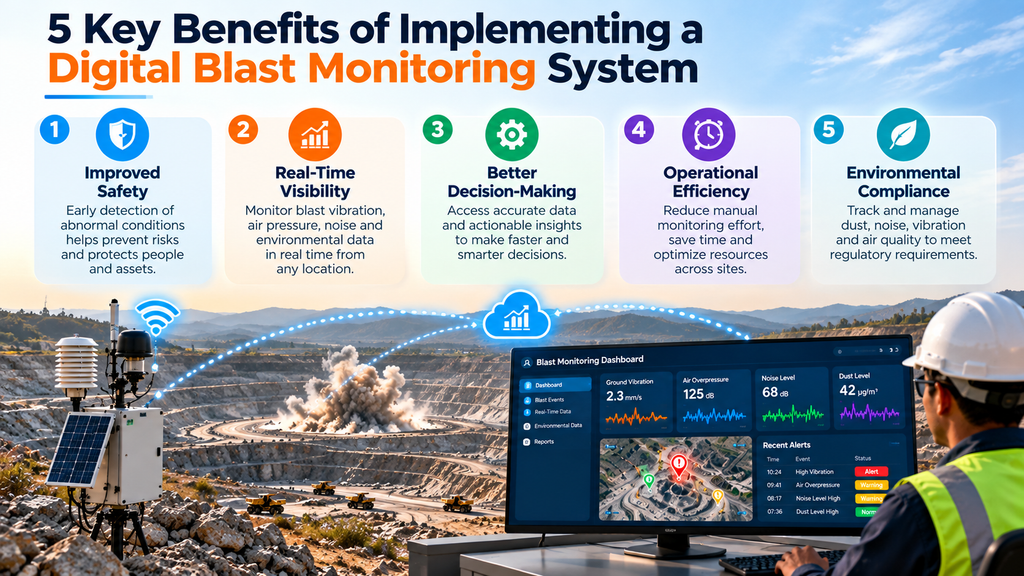
If you are weighing up the move to digital, this guide lays out the five key benefits of implementing a digital blast monitoring system — from enhancing safety to smarter decisions — and why a modern blast vibration monitoring solution — a complete solution for blast monitoring — is fast becoming the industry norm.
▶ Watch: Real-Time IoT Monitoring in Action
Table of Contents
- What is a digital blast monitoring system?
- The 5 benefits at a glance
- 1. Enhanced safety
- 2. Real-time data and monitoring
- 3. Compliance and accurate records
- 4. Better decisions and insights
- 5. Efficiency and lower cost
- How to implement one
- FAQs and conclusion
What Is a Digital Blast Monitoring System?
A digital blast monitoring system uses connected sensors and software to automatically measure, record, and analyse the vibration and air overpressure from every blast. Instead of manual seismographs read one at a time, a digital vibration monitoring system streams blast data to a central platform in real time, and connected monitoring systems keep every reading in one place, — the journey we cover in from sensor to dashboard.
In short, it replaces slow, manual data collection with continuous, automatic, connected monitoring. That single shift unlocks the five benefits below.
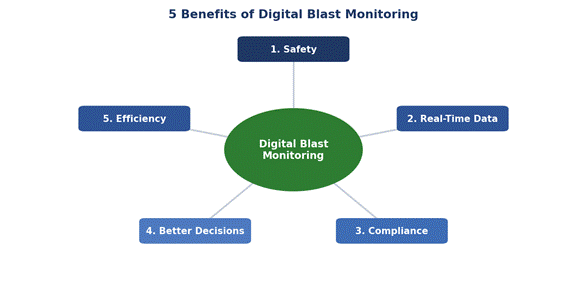
Digital vs Traditional Blast Monitoring
It helps to see what changes when monitoring goes digital. Traditional monitoring relies on standalone seismographs that record a blast and store the data until someone visits the site to download it. That works for a single, occasional blast, but it means results are always hours or days old, coverage depends on someone being present, and every site keeps its own separate records.
A digital vibration monitoring system flips this. Connected sensors capture every blast and transmit the data automatically, so results are available in real time, from anywhere, in one place. There is no waiting, no manual download, and no gap between a blast happening and the team knowing about it. That difference is the source of all five benefits below.
The 5 Benefits at a Glance
Here is a quick overview before we explore each benefit in detail:
| # | Benefit | What it delivers |
| 1 | Enhanced safety | Instant warning of excessive vibration and air overpressure |
| 2 | Real-time data & monitoring | Live readings and alerts instead of delayed downloads |
| 3 | Compliance & accurate records | Verifiable proof every blast met industry standards |
| 4 | Better decisions & insights | Data-driven blast design and post-blast analysis |
| 5 | Efficiency & lower cost | Optimised blasting and fewer disputes and delays |
1. Enhanced Safety
The most important benefit is safety and the ability to enhance safety across the site. A digital system continuously monitors the vibration and air overpressure from each blast and alerts the team instantly if a reading approaches a limit. That immediacy helps protect nearby structures from damage and reduces the potential impact of blasting on people and property.
Because the system watches every blast automatically, nothing slips through between manual checks. Combined with careful monitoring of ground vibration and PPV, a digital system turns safety from a periodic check into constant, real-time protection — the same principle behind how blast sensors improve mine safety and operational control.
2. Real-Time Data and Monitoring
Traditional monitoring has a built-in delay: someone has to collect the data before anyone can see it. A digital system removes that gap entirely, delivering real-time data the moment a blast fires. Real time monitoring means an exceedance is known instantly, not discovered the next day.
This is transformative for both safety and operations. Teams can respond immediately, and managers can see results from anywhere — even across multiple sites at once, as covered in remote blast monitoring. Real-time visibility is exactly why real-time blast monitoring is critical for modern operations.
3. Compliance and Accurate Records
Blasting is tightly regulated, and proving compliance requires accurate, complete records. A digital blast monitoring system automatically captures and stores accurate data for every blast, checked against the relevant industry standards. There are no gaps, no lost paperwork, and no question of whether a reading was recorded.
This automatic, verifiable record is invaluable when a regulator asks for evidence or a resident raises a complaint. Instead of scrambling through files, the operator has a complete, time-stamped history of every blast at their fingertips — proof that each one met the required limits.
4. Better Decisions and Valuable Insights
A digital system does not just record blasts — it turns them into valuable insights. By analysing blast data across many events, often with machine learning algorithms, it reveals which blast designs produce the least vibration and where problems recur. This is the foundation of data driven blasting, and it powers detailed post blast analysis.
These insights support better post-blast analysis and smarter blast design, helping teams reduce vibration while maintaining productivity. It is a benefit explored fully in our guide on how blast monitoring data supports better decision-making, and it turns routine monitoring into a tool for continuous improvement.
5. Efficiency and Lower Cost
Finally, a digital blast monitoring system improves efficiency and reduces cost. Automating data collection frees skilled staff from manual rounds, and remote access removes the need to travel between sites. Fewer disputes, faster compliance reporting, and better-optimised blasts all save time and money.
Over time, the insights a digital system provides also improve the blasting itself — better fragmentation and less wasted energy mean more efficient resource extraction. What begins as a monitoring upgrade becomes a driver of overall operational efficiency, paying back its cost many times over as the gains compound across every blast.
Who Benefits Most from Going Digital?
Every blasting operation gains from digital monitoring, but some feel the benefits most sharply. Operations near communities, roads, or sensitive structures gain the most from instant safety alerts and defensible compliance records. High-tempo mines and quarries that blast frequently benefit from the time saved on manual data collection. And companies running several sites gain the most from central, remote visibility of every location at once.
For these operations especially, the question is no longer whether to go digital, but how soon. The cost of a single incident, dispute, or compliance failure that digital monitoring would have prevented usually dwarfs the cost of the system itself — which is why adoption is accelerating across the resource extraction industry.
How to Implement a Digital Blast Monitoring System
Adopting a digital system is straightforward with the right approach. Start by defining your goals — safety, compliance, or insight — and identifying the sensitive locations to monitor. Choose connected sensors and a platform suited to your sites, ensuring reliable data transmission even in remote areas. Integrate the system so alerts reach the right people, and use the accumulated data to keep improving. The complete blast monitoring sensor-to-insight pipeline shows how the pieces fit together.
What to Look for in a Digital Blast Monitoring System
Not all digital systems are equal, so it is worth knowing what matters when choosing one. Look for reliable, real-time data transmission with local buffering, so no blast is ever lost even when connectivity drops. Check that the sensors and instruments meet the relevant industry standards for accuracy and calibration, because defensible compliance depends on it. Make sure the platform presents clear dashboards and instant alerts, not just raw data, so insights actually reach the people who act on them.
Finally, consider how well the system scales and integrates. A good solution grows as you add sites, keeps every blast in one central record, and connects to the wider tools your operation uses. Choosing on these criteria — reliability, accuracy, clarity, and scalability — ensures the system delivers all five benefits rather than just collecting data. An experienced partner can help match the right setup to your specific sites and goals.
Conclusion
Implementing a digital blast monitoring system delivers benefits that reach across an entire operation — safer blasting, real-time visibility, effortless compliance, smarter decisions, and greater efficiency. Together, they turn blasting from a risk to be managed into a well-controlled, data-driven process.
As monitoring goes digital across the industry, the operations that adopt it gain a clear edge in safety and performance. Explore our related guides on real-time blast monitoring and blast monitoring data and decision-making to see these benefits in action.
Go Digital with Brilliant Info Systems
Brilliant Info Systems delivers a complete blast vibration monitoring solution — digital, real-time, and connected — powered by IoT and smart sensors. Contact our team to implement a digital blast monitoring system across your operation.
Frequently Asked Questions
What is a digital blast monitoring system?
It is a system that uses connected sensors and software to automatically measure, record, and analyse the vibration and air overpressure from every blast, delivering real-time data and alerts to a central platform.
What are the main benefits of a digital blast monitoring system?
The five key benefits are enhanced safety, real-time data and monitoring, stronger compliance with accurate records, better data-driven decisions, and improved efficiency with lower cost.
How does a digital system improve safety?
It continuously monitors every blast and alerts the team instantly if vibration or air overpressure approaches a limit, protecting nearby structures and reducing the potential impact of blasting in real time.
Does a digital system help with compliance?
Yes. It automatically captures accurate, complete records of every blast, checked against industry standards, giving operators verifiable proof of compliance without manual paperwork.
How does digital blast monitoring support better decisions?
By analysing blast data across many events, often using machine learning algorithms, it produces valuable insights and post-blast analysis that guide smarter blast design and continuous improvement.
Is a digital blast monitoring system worth the investment?
For most operations, yes. The gains in safety, compliance, insight, and efficiency typically outweigh the cost, and the system pays for itself by preventing incidents, disputes, and delays.